BANJA LUKA, REPUBLIKA SRPSKA – In the center of Banja Luka, at a memorial dedicated to those killed in the wars accompanying the breakup of Yugoslavia in the 1990s, another, smaller memorial had appeared. It showed the photo of a man decked in military garb and was accompanied by floral wreaths. It was for General Ratko Mladic.
The former commander of the Bosnian Serb Army died on August 27 at the age of 84, while serving a life sentence imposed by the International Criminal Tribunal for the former Yugoslavia (ICTY).
Yet in Republika Srpska, the Serb-majority entity of Bosnia and Herzegovina, the reaction encountered by The Jerusalem Post was often far removed from the international condemnation that followed his death.“Mladic defended us when we were under attack. He fought for Serb rights,” one Banja Luka resident told the Post.
Others who spoke with the Post during a visit to the city similarly described Mladic as a hero, reflecting the extraordinary divide that continues to surround his legacy more than three decades after the end of the Bosnian War.
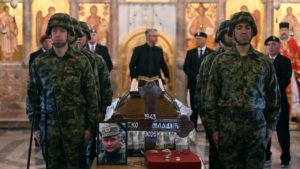
Those feelings, often buried in the hope of looking to the future, rose to the surface again when Mladic died last week and were visible again on Monday, when thousands gathered outside a Serbian Orthodox church in Belgrade ahead of the general’s burial. Mourners carried Serbian flags and photographs of the former military leader, while free buses ran from towns in Serbia and Bosnia for those wishing to attend. His coffin was displayed inside the church as his family received condolences.
The reverence sits alongside a judicial record that is among the most serious to emerge from the wars that accompanied the breakup of Yugoslavia.
The ICTY convicted Mladic in 2017 of genocide over the 1995 Srebrenica massacre, as well as persecution, extermination, murder, deportation, and forcible transfer. Around 8,000 Bosniak Muslim men and boys were killed following the fall of the town of Srebrenica in July 1995.
He was also convicted of crimes connected to the campaign of sniping and shelling against civilians during the siege of Sarajevo and the taking of UN personnel hostage. His life sentence was upheld on appeal in 2021.
Mladic was, alongside former Bosnian Serb political leader Radovan Karadžić, the highest-ranking Bosnian Serb official to be convicted by the Hague tribunal, while former Serbian and Yugoslav president Slobodan Milošević died in custody in 2006 before a verdict could be reached in his war crimes trial.
President Milorad Dodik, the longtime dominant political figure in Republika Srpska, made little attempt to disguise the depth of the divide when he spoke exclusively with the Post in Banja Luka last week.
“What the West and the Muslims have done is turn General Mladic into an icon of identification for the Serbs, whatever anyone may think about him,” Dodik said.
Dodik argued that attempts to criminalize the glorification of convicted war criminals in Bosnia have strengthened rather than diminished Mladic's standing among some Serbs.
“You can prohibit someone from saying something publicly, but you cannot prohibit people from saying what they want in private conversations,” he told the Post.
What particularly concerned Dodik, though, was that the phenomenon was no longer restricted to the generation that fought or lived through the war, and the fierce Serb nationalism of the 1990s has reached down through to today’s youth.
“Today these people – young people born after the war – are going into the streets and paying tribute to General Mladic,” he said. “Excuse me, how am I supposed to prohibit that? Should I use force?”
The conversations the Post had in Banja Luka suggested that, whatever the reasons, Mladic’s reputation as a defender of the Serbs has survived into a generation with little or no personal memory of the conflict. Many of those who spoke to the Post – Bosnian citizens who identify first and foremost as Serbs – expressed deep contempt for the Bosnian state and distrust of Sarajevo; politically and culturally, their eyes remain firmly turned toward Belgrade.
Dodik also rejected the international narrative surrounding Mladic's responsibility, arguing that the former general had been made into a symbol of what many Serbs regard as the unequal treatment of the different sides in the Bosnian War.
“A myth has been created around Mladic – the image of a beast that certain liberal circles needed in order to portray him that way,” Dodik said. This was also repeated among those whom the Post spoke with. Those who spoke to the Post did not necessarily deny that crimes had been committed by Bosnian Serb forces, but repeatedly returned to what they regarded as the unequal judgment of the war: that crimes were committed by all sides, while the Serbs alone have come to be defined by them.
Mladic's death has once again exposed divisions that have never fully disappeared since the 1992-1995 war.
Before his death, Mladic had personally requested to be buried in Belgrade alongside his daughter, Ana, who died in 1994.
“During his lifetime, he asked to be buried in the cemetery where his daughter is buried,” he said. “Among us Christians, Orthodox Christians, that is a definitive and irrevocable decision, and we cannot change it.”
The Serbian government's treatment of Mladic following his death has meanwhile produced a new confrontation with Europe. EU Enlargement Commissioner Marta Kos canceled a planned visit to Serbia last week, saying the glorification of convicted war criminals was incompatible with the principles of reconciliation and respect for victims expected of countries seeking EU membership.
Dodik characterized the criticism surrounding the funeral as “hysteria” and argued that it would only reinforce the sense among Serbs that Mladic and, by extension, they themselves were being treated unjustly.
“I think all of this would have passed much more peacefully if the Muslims had not started this hysteria,” he said. “Then the Serbs reacted in defense of their dignity.”
That sense of grievance helps to understand what was visible in Banja Luka in the days following Mladić's death. The legal judgment on Ratko Mladic was delivered long ago. His final appeal failed five years before his death, leaving in place a life sentence for genocide, crimes against humanity and war crimes.
But judicial judgments and collective memory do not necessarily travel together.
Three decades after Srebrenica, the memorial in central Banja Luka, the conversations with residents, and now the thousands who turned out in Belgrade for his funeral demonstrate that for many Serbs, Mladic remains something very different from the man described in the judgments of The Hague.
For the resident who spoke to the Post, at least, there was little ambiguity.
“He defended us,” he said.