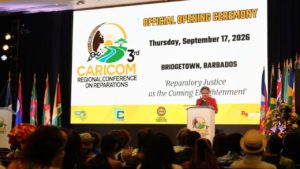
Caribbean officials are considering legal strategies in an effort to get the United Kingdom into a negotiation for a reparations deal, The Guardian reported on Saturday.
The recent push came during the CARICOM Regional Conference on Reparations, which took place from Thursday to Saturday, the Guardian reported.
The conference was hosted by Barbados, and, according to its website, featured between 150-20 representatives from numerous Caribbean nations, including governmental officials, academics, activists, and cultural leaders.
Barbados Prime Minister Mia Mottley compared slavery to the Holocaust during the conference, the Guardian cited, pointing out that the German government had repaid the Jewish community $95b.
She said that she did not want anybody to "diminish the fact that in this country here, which I have the honor to lead, that from settlement in 1627, 400 years ago next year, for 211 years, not six, people were treated as chattel.
“If they dared to speak or to do things that were displeasing, their lives and limbs were put at risk. The evidence is clear. What is absent is the will,” she said.
“We need a concrete, multigenerational plan,” Ralph Gonsalves, former prime minister of St Vincent and the Grenadines who now serves as an elder and adviser for the Repair Campaign, said.
According to the Guardian, Gonsalves challenged claims that Britain was not obligated to pay reparations due to it not having violated historical laws during the era of transatlantic slavery.
“The fact is that the consequences of slavery fall squarely under the Committee on the Elimination of Racial Discrimination, which obliges states to help address the consequences of native genocide and slavery,” Gonsalves said.
Among the legal strategies which may be employed by Caribbean nations is going to the International Court of Justice, David Comissiong, deputy chair of the Barbados National Task Force on Reparations, said.
Another option currently being employed by Jamaica, the Guardian cited Comissiong as saying, was “trying to engage with the national legal judicial system of the UK, the privy council.”
The chair of the CARICOM Reparations Commission, Prof Sir Hilary Beckles, called reparations a matter of justice.
“When Jamaica took its petition to the UK, we had to surround that petition with the fact that when Jamaica became independent in 1962, 80% of the black people in Jamaica could not read or write,” he said. “After 300 years of British colonization, they moved into independence with 80% illiteracy. How do you build a modern nation, not even a competitive economy, with 80% illiteracy?”