• English
  • Русский

India arrests over 200 terror operatives linked to Pakistan ahead of Independence Day

Indian security agencies arrested more than 200 “terror operatives” linked to Pakistan, thwarting potential “subversive attacks” around the country’s Independence Day last week, Home Minister Amit Shah said on Monday, in one of the largest such crackdowns in years.

A multi-state operation against what Shah said was a terror group backed by Pakistan’s spy agency Inter-Services Intelligence (ISI) was carried out across 14 Indian states on August 12, three days before India celebrated its 80th year of freedom from British colonial rule.

A spokesperson for Pakistan’s foreign ministry did not immediately respond to a request for comment from Reuters. Pakistan has in the past denied allegations that it backs militant groups blamed for attacks in India.

"[The] Modi government destroyed the ISI-backed terror group Shahzad Bhatti Network ahead of Independence Day and thwarted its plans for subversive attacks by arresting more than 200 operatives," Shah said in a post on X/Twitter.

Shah said agencies had recovered pistols, live cartridges, grenades bearing Pakistan Ordnance Factory markings and crude bombs.

India and Pakistan both claim that the other fosters and abets terrorism in their country.

The nuclear-armed neighbors were involved in a four-day military conflict last year after India blamed Pakistani attackers for the killing of 26 men at a tourist destination in Indian Kashmir.

Defense in Lindsay Clancy case claims psychosis behind her killing her children

Content warning: This article contains content that some may find disturbing, including descriptions of child deaths and suicide attempts.

The murder trial of Lindsay Clancy, a woman who killed her three children, is set to resume on Monday for its fourth week of testimony, with the prosecution continuing its presentation and the defense preparing for its opportunity to call witnesses and experts.

Clancy has pleaded not guilty to first-degree murder in the deaths of her children – five-year-old Cora, three-year-old Dawson, and eight-month-old Callan – in January 2023. 

While Clancy admitted to killing her children, the defense has argued that due to postpartum psychosis and overmedication, she should not be held criminally responsible. The prosecution said Clancy planned the killings, carried them out “deliberately and meticulously,” and then faked a suicide attempt. 

Clancy's ex-husband Patrick Clancy described the day of the killings in his testimony, saying he had gone out to pick up medicine for their oldest child and a takeout order Lindsay Clancy had placed at a local restaurant. He came home and found their second-floor bathroom covered in blood and the window open. Lindsay Clancy was lying on the ground outside with deep cuts on her wrists and another cut across her neck. She told him she had tried to kill herself, and when asked where the children were, she said they were in the basement.

Patrick Clancy found the three children unresponsive with exercise bands wrapped around their necks. Cora and Dawson were pronounced dead that night, and Callan died three days later, never having regained consciousness. Lindsay Clancy was permanently paralyzed from the waist down.

The prosecution used first responder testimony calling Clancy’s injuries “superficial” and described them as “not actively bleeding” at the time of their arrival to point towards the suicide attempt being staged in an attempt to cover up her state of mind at the time of the killings. However, the defense disputed the claims and suggested the unusually cold temperatures may have contributed to the lack of bleeding at the time. 

According to the defense, Clancy was experiencing a psychotic episode at the time and that she heard a voice telling her that "this is your last chance. Kill the children so you can kill yourself."

While Clancy appeared outwardly functional, the defense claimed that the psychosis caused her to believe there was only one course of action: to kill her children and then herself.

Multiple psychiatric providers testified to Clancy’s state of mind leading up to January 24. In the months prior, one psychiatrist, Dr. Jennifer Tufts, said that Clancy had tried at least 10 medications to find the right combination and complained of insomnia, depression, and anxiety resulting from the medication. 

"Anxiety was really bad even before medication. Now hard to differentiate. Overnight, racing thoughts. Paranoid of getting suicidal thoughts, something bad happening, doesn't want to be alone," Tufts said while reading from her notes.

However, Tufts said she had not thought Clancy was ever psychotic, and in an appointment the day before the murders, she never mentioned any plans to kill her children. She told the court she was surprised to hear that Clancy had called a suicide hotline twice over the course of her treatment.

Psychiatric nurse practitioner Rebecca Jollotta also testified that while treating Clancy, she was concerned Clancy was experiencing a mixed manic or hypomanic state and recommended a higher level of care, but did not believe Clancy had postpartum psychosis when she treated her.

Clancy visited multiple treatment centers, including staying multiple days in a locked ward facility in early January.

Notes on Clancy's phone written in the months leading up to the killings included fears over taking new medication and details of her anxiety and depression.

One note, last edited in November 2022, detailed her feeling "sad and depressed" about not being able to parent her youngest child the same way she raised her first, writing that she "sort of resent[s] my other children because they prevent me from treating Cal like my first baby. And I know that’s not fair to them.”

Another note from November contained her concerns over sleep training her child, saying she felt 'slightly traumatized by the sleep training," but only when she was "severely sleep deprived and paranoid."

She also wrote a list of affirmations including “I will get through this. I will overcome postpartum anxiety and depression. I am a great mom. I love my kids.”

Records of Clancy's cellphone search history from January included several searches about prescription medications, mental disorders including schizophrenia, psychosis, hallucinations, and bipolar disorder, whether or not a sociopath could be treated, as well as methods of suicide.

If Clancy is found guilty of murder, she could face life in prison. In the event that she is found not criminally responsible, she will likely be committed to a psychiatric hospital.

Vietnam targets natural birth sex ratio by 2035 with crackdown on fetal sex selection

Vietnam wants to bring its sex ratio at birth down to the natural level of about 106 boys for every 100 girls by 2035, according to a draft plan from the Ministry of Health that proposes action against sex-selection services and efforts to challenge long-standing preferences for sons.

The draft plan, which was released on Saturday for consultation and was reviewed by Reuters, targets a reduction in the sex ratio at birth to below 109 boys per 100 girls by 2030 and then to the natural level by 2035.

The skew towards boys in Vietnam’s sex ratio at birth has been among the highest in Asia for years. The draft says the ratio stood at 112.2 boys per 100 girls in 2016, peaked at 114.8 in 2018 and eased to 110 in 2025.

Among the proposed measures to achieve the goal are stricter enforcement of laws banning fetal sex selection, stronger inspections of medical facilities, greater monitoring of online advertising for sex-selection services, as well as public campaigns.

The ministry attributed the imbalance in Vietnam’s sex ratio to a persistent preference for sons, pressure to produce male heirs, shrinking family sizes and easier access to prenatal sex-identification technologies.

The draft paper warned that a prolonged surplus of men could create long-term demographic and social pressures, including difficulties in the marriage market, rising gender inequality, gender-based violence, trafficking in women and girls, and broader challenges to social stability.

Myanmar president Min Aung Hlaing departs for Russia to expand energy and economic ties

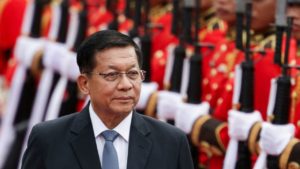
Myanmar junta chief-turned-president Min Aung Hlaing left for Russia on Monday for his first official visit to the country since he assumed the presidency in April, according to state media.

Russia will be the fifth country Min Aung Hlaing has visited since becoming president, with official trips to India, China, Laos, and, earlier this month, Thailand.

The former general is the subject of a raft of Western sanctions and has been on a quest for international legitimacy since winning a vote in parliament to become president, which came after an election dominated by an army-backed party in the absence of a viable opposition.

Min Aung Hlaing made four visits to Russia as junta chief, the first in June 2021 to attend a security conference, five months after seizing power in a coup. He visited twice in 2022 and again in March 2025, when he held formal talks with Russian President Vladimir Putin in Moscow.

Russia is hoping to open up opportunities in Myanmar for its energy companies. The two countries signed an agreement to construct a small-scale nuclear power plant in Myanmar when Min Aung Hlaing met Putin in 2025.

Russia and Myanmar signed a memorandum on investment cooperation for the strategically located Dawei Special Economic Zone in February 2025, including the construction of a port and an oil refinery.

Min Aung Hlaing's latest trip includes a Myanmar-Russia business forum. Joining him will be the chief minister of the Tanintharyi region, where Dawei is located, and the head of Myanmar's aerospace agency, according to state media.

Defense ties have grown in recent years, with Moscow providing army training and university scholarships to thousands of Myanmar soldiers, as well as selling arms to a military blacklisted by some Western countries.

Russia also said earlier this year that it would help train Myanmar’s first cosmonaut.

Trump says US military to reduce military exercises with South Korea, cites North Korea relations

US President Donald Trump said on Sunday he had instructed the Pentagon to substantially reduce joint military exercises with South Korea in a social media post that also mentions Seoul’s refusal to take part in actions against Iran.

Trump said in a post on his Truth Social site that, although it was too late to cancel the exercises entirely, he was “not happy” that the United States had previously agreed to participate. The US president also cited his “very good relationship” with North Korean leader Kim Jong Un.

"These exercises are not only costly… but send a signal that is totally inappropriate and hostile, to a Country that, as long as Donald J. Trump has been President, has been unthreatening and respectful," he wrote.

Trump also pointed to South Korea's stance on the US-Israeli conflict with Iran.

“While somewhat unrelated (?), I recently asked the President of South Korea if they would like to join us in the Denuclearization of the Islamic Republic of Iran, and they said, ‘No thanks!'” Trump wrote.

The annual Ulchi Freedom Shield joint military drills are scheduled to run from August 17 to 27.

Ukraine could launch ballistic missiles in three months, former defense minister says

Ukraine could strike Russia with domestically produced ballistic missiles within the next few months, the country’s former defense minister Mykhailo Fedorov told CBS on Sunday.

Fedorov, who was recently ousted by Ukrainian President Volodymyr Zelensky, said that Ukraine could be able to launch the missiles within three to six months’ time

"We need to defeat Russia in every technological cycle, and we have to make decisions 24/7," he told CBS.

Fedorov has often been credited with being the architect of Ukraine’s current war strategy. While he noted that it would be difficult to predict exactly when Ukrainian ballistic missiles would be deployed, he emphasized that Ukraine has “no choice but to do it.”

In June, Ukrainian defense company Fire Point began testing a ballistic model, which would allow Kyiv to respond to Moscow’s attacks. Fire Point has also said that it aims to begin launching interceptor missiles, but they will likely not be available until 2027. 

While it is on the uptick, Ukraine struggles to intercept Russian ballistic missiles because of its mass interceptor shortage.

On Sunday evening, the Ukrainian Air Force was unable to intercept any of the ballistic missiles that Russia fired at the country.

As such, Ukraine has mainly relied on long-range drones and cruise missiles to attack Russia.

Zelensky has been publicly pleading with the US and Europe for more interceptor missiles. In an interview with CNN, he said he has only about 10% of the interceptor missiles he needs.

If the US “sells us 5%, we will go through the winter and save people’s lives. If they can sell us 10%, we will destroy all the Russians’ ballistic missiles. I have 1%,” he said.

After Trump walked back his public commitment to give Ukraine the Patriot missile interceptors, representatives from Lockheed Martin, which produces the Patriots, went to Kyiv to start discussions. But even if Ukraine does get the license, it would take at least a year, if not more, to produce them.

Ukraine has notably been receiving even fewer Patriot missiles than before due to the US interceptor shortage that stemmed from the war with Iran.

“I hope that I will get it,” Zelensky told CNN, regarding the interceptors.

“I don’t have 5% now, and I don’t have such an acceptance. And this is for me a big challenge, one of the biggest I have had from the very beginning of this war.”

In response, a White House official told CNN that the Pentagon “is currently exploring several potential pathways for future defense industrial cooperation with Ukraine.

“These discussions are in the exploratory phase; no specific industrial cooperation initiatives have been decided upon or guaranteed at this stage,” the official added.

“We must prioritize protecting these exquisite systems and expanding overall production of critical weapons systems for the US warfighter and for our partners and allies.”

Zelensky also told CNN that he would not concede any territory in Ukraine’s Donbas region, which Russia has repeatedly sought to control.

“Russia begins to speak about this war, and they speak about territory,” he said.

“The key question is why he will not come again with 1 or 2 additional million soldiers after a big pause. Why will he not come again to occupy us?”

He then signaled that he agreed with some assessments that Putin could try to expand the war in Ukraine to take on NATO.

“He doesn’t know how to end this war without big occupation or big victory for his society,” he said.

“It’s more simple to find some smaller country … for him, it will not be important if this country is in NATO or not in NATO. He wants quick victory, 100% sure that he will win, occupy or destroy or control.”

Drone strikes, intelligence chief’s killing expose Libya’s fragile balance – analysis

Drone attacks on energy facilities in western Libya and the assassination of a senior intelligence official in the east have renewed fears of instability as Libyan factions maneuver ahead of possible political negotiations.

For more stories from The Media Line go to themedialine.org

No evidence has emerged connecting the two sets of events, and no group has claimed responsibility for either. Their timing has nonetheless raised questions about whether Libya faces another brief outbreak of violence or a broader contest for influence.

Maj.-Gen. Fawzi al-Mansouri, head of military intelligence for Khalifa Haftar’s eastern-based forces, was killed in Benghazi on Monday night, August 10, when an explosive device detonated at his vehicle in the Hawari district, according to security officials and the eastern General Command.

Al-Mansouri was buried the following day at a funeral attended by senior military figures, including Saddam Haftar, one of Khalifa Haftar’s sons. A security committee has opened an investigation, but authorities have not publicly identified a suspect or motive.

The assassination eliminated one of the most senior officials in an eastern security establishment that has portrayed Benghazi and much of eastern Libya as having left behind the instability of earlier years.

Hundreds of kilometers to the west, attacks were hitting some of the country’s most important energy facilities.

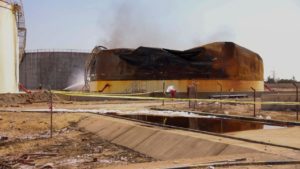
Drone strikes began targeting facilities in Zawiya on August 9. The following night, a drone hit a gasoline-storage tank at the Zawiya oil complex, west of Tripoli, causing a major fire and the tank’s collapse. The tank held approximately 4.5 million liters of gasoline when it was struck, according to Libya’s National Oil Corporation.

Another drone landed near a second tank without causing reported casualties or damage. Further attacks continued into August 11.

The National Oil Corporation said firefighters had contained the blazes and that the refinery itself was not damaged, although production was briefly disrupted. It warned that more attacks could force it to suspend operations.

The complex includes Libya’s largest operating refinery, which can process approximately 120,000 barrels per day. It is connected to the Sharara oil field and plays a central role in the country’s energy production and fuel-distribution network.

Libyan Prime Minister Abdul Hamid Dbeibah, who heads the internationally recognized Government of National Unity in Tripoli, condemned the strikes as organized crime and promised to hold those responsible accountable.

Another drone struck the South Zawiya electricity substation on August 12, setting it ablaze and causing widespread outages. Libya’s state-run General Electricity Company said more than 700 megawatts of the nearby power plant’s 1,300-megawatt capacity remained unavailable.

US energy company GE suspended work at the power station and withdrew its technical teams because of the security situation.

The attackers and their objectives remain unknown. Zawiya is divided among armed groups with shifting alliances, and tensions have grown between Dbeibah’s government and forces associated with Mohamed Bahroun, a powerful commander in the city.

Libya has been divided between rival centers of authority for more than a decade. Dbeibah’s government operates from Tripoli, while authorities backed by Haftar’s forces control the east. A 2020 ceasefire ended the last major nationwide war but failed to produce unified political, military, or security institutions.

The latest violence comes as Libyan leaders and foreign governments seek arrangements that could narrow the east-west divide.

Misbah Omar, a Libya-based analyst at the Institute for Integrated Transitions and a member of the Mediterranean Platform, said the attacks could be part of a larger contest, although no wider pattern has yet been established.

“If this assessment is correct, what we are witnessing may represent an initial phase in the restructuring of Libya’s political and security landscape – one aimed at allowing the main actors to consolidate or redefine their respective spheres of influence before moving toward a clearer political process,” Omar told The Media Line.

Zawiya is particularly important in any contest over western Libya. The city sits west of Tripoli at the junction of armed influence, energy infrastructure, migration routes, and economic networks.

The attacks raise the possibility that armed factions or their opponents are shifting their focus from direct clashes to the resources and supply systems that sustain military power.

“Such actions would represent a significant shift in the nature of the confrontation,” Omar said. “Rather than focusing exclusively on the armed formations themselves, pressure could increasingly be directed toward the economic and logistical networks that sustain their influence and operational capacity.”

Potential targets could include infrastructure, revenue sources, supply routes, and other assets that help armed groups maintain their position, he added.

Ibrahim Mousa Said Grada, a former Libyan ambassador to Sweden and former UN adviser, also described Zawiya as central to the struggle over political power and economic resources.

“This happened in Zawiya, a city that deserves to be described as afflicted and targeted because it has become a meeting point for the contradictions of politics, conflicts of interest, and disputes over the division of power and resources in Libya,” Grada told The Media Line.

The violence coincides with renewed US efforts to encourage cooperation between Libya’s rival authorities.

Massad Boulos, senior adviser to US President Donald Trump for Arab and African affairs, has promoted an initiative focused on institutional reunification and economic cooperation. He has met Haftar, Dbeibah, and other political and military figures across Libya.

Published accounts describe the initiative as an effort to reach agreements between Haftar’s eastern authorities and Dbeibah’s Tripoli-based government, with energy investment and economic development offered as incentives.

The plan remains controversial, and many of its details have not been made public. Critics warn that a power-sharing agreement could preserve the authority of Libya’s current leaders and armed factions rather than build representative national institutions.

Omar said the US approach seemed to favor a series of limited agreements rather than a comprehensive settlement.

“If this trajectory continues, the initiative could enter a more practical phase during the final quarter of this year and the beginning of next year, operating along two parallel tracks: economic and political, supported by corresponding security arrangements on the ground,” he said.

Grada was less optimistic about its immediate prospects.

“The Boulos initiative ‘appears’ to have been placed in a freezer during this scorching summer, so that it does not die or become buried altogether,” he said.

The recent attacks do not show that Libya’s factions have agreed on a new division of power. They could instead represent attempts by competing groups to improve their positions before negotiations, whose timing and structure remain unclear.

Al-Mansouri’s assassination creates another problem for the east. Grada said the loss of its military intelligence chief came at a sensitive time for Libya’s divided security services.

“At the same time, the absence of the head of military intelligence for the eastern Libyan forces coincides with the continuing dispute over the leadership of the General Intelligence Service, or external security apparatus,” Grada said. “This means an intelligence vacuum and state of confusion at a particularly dark and sensitive moment domestically and during a highly unstable and critical international environment.”

Foreign involvement adds to the uncertainty. Russia, Turkey, the US, European powers, and regional governments retain varying degrees of political, economic, and security influence in Libya.

“There is an increasing possibility that Libya could be transformed into an arena for proxy warfare between intelligence services and their military and media arms, as international and regional conflicts and rivalries expand and deepen,” Grada said.

The latest violence does not necessarily mean that Libya is heading back to nationwide war. Omar said a series of limited moves intended to change the balance of power was more likely than an immediate, large-scale confrontation.

“However, these developments should not necessarily be interpreted as evidence of an imminent comprehensive military confrontation,” he said. “A more plausible scenario may be a series of calibrated and limited moves designed to alter the balance of power gradually, while leaving room for negotiations and political accommodation.”

The next political agreement may depend as much on events outside formal negotiations as on what happens at the table. Control of territory, energy assets, and security institutions will help determine what Libya’s competing factions are willing – and able – to accept.

The Zawiya strikes and al-Mansouri’s assassination do not prove that anyone is carrying out a coordinated plan to redraw Libya’s balance of power. They do show how quickly an attack on an oil tank, power station, or security chief can unsettle a country whose rival authorities have never fully resolved the conflict between them.

UK Dept Ed. reviewing Muslim schools run by Al-Khair Foundation following reports of Hamas ties

The UK's Department of Education (DfE) is assessing information regarding four Muslim independent schools after the Charity Commission opened a statutory inquiry into the Al-Khair Foundation, the organization that runs the schools.

As reported by the The Jerusalem Post on August 9, the UK Charity Commission is investigating the prominent Muslim-registered charity Al-Khair Foundation following reports of alleged Hamas connections.

Al-Khair was set up to advance religion, promote education, support social welfare, build religious harmony, and offer relief to victims of disasters.

However, the Commission said it received a complaint alleging the charity and its partners had connections to Hamas and had also funded Hamas.

The regulator immediately started examining the serious concerns raised and gathered more information to inform its assessment. The Commission has now escalated its engagement to a statutory inquiry.

This follows the arrest of Mohammad Yousef Hasna, an individual employed by Al-Khair Foundation, in the UK last week. Hasna was extradited to the US and charged with conspiring to provide material support to Hamas.

This prompted UK Lawyers for Israel (UKFLI) to send a report to the DfE's Counter-Extremism Division on 10 July 2026, detailing Al-Khair’s links to the Hamas terrorist group and raising concerns about safeguarding, extremism, and compliance with the Prevent duty at schools operated by the charity.

The Post viewed correspondence between UKFLI and the DfE regarding the Al Khair Foundation. DfE said it is “continuing to work with other government departments and agencies to assess all the information that has been provided to us and determine next steps”

The four schools run by Al Khair Foundation are Al-Khair Preparatory School in Croydon; Al-Khair Preparatory School in Oldbury, Birmingham; and Al-Khair Secondary Schools for Boys and Girls in Croydon.  Over 550 children attend the four schools. The annual school fees are £5468 for the Croydon schools and £3600 for the Birmingham school.

UKLFI's letter to the DfE warned that the schools could be exposed to safeguarding and Prevent-related risks arising from Al-Khair’s employment of individuals allegedly linked to proscribed terrorist organizations. UKLFI's investigation found that at least two people employed by Al-Khair Foundation had been identified as Hamas operatives, while another employee had significant links with Hamas figures.

Schools are subject to the statutory Prevent duty, requiring them to assess the risk of pupils being drawn into terrorism, challenge extremist narratives and manage potentially harmful external influences. UKLFI said the evidence it had gathered justified examination of whether those safeguards were operating effectively at the Al-Khair schools.

A UKLFI spokesperson said, "The allegations concerning Al-Khair Foundation are extremely serious in themselves, but they become still more concerning when an organization facing such allegations is also responsible for the education and safeguarding of children."

"UKLFI alerted the Department to these concerns because schools must have robust procedures to protect pupils from extremist influence and from being drawn into support for terrorism. We hope the Department will now examine carefully the governance of all four schools, their relationships with the Foundation and its personnel, and whether their safeguarding and Prevent obligations have been properly discharged.

"The Charity Commission's statutory inquiry and the separate criminal allegations now being pursued by the US authorities underline why these concerns required urgent investigation."

Could double jeopardy end Luigi Mangione’s New York state murder case? – explainer

On Friday, Luigi Mangione pleaded guilty to federal stalking charges and admitted to killing UnitedHealthcare CEO Brian Thompson in 2024.

But Mangione’s trial is far from over. He still faces state charges in New York for second-degree murder and other weapons-related charges.

On Friday, Mangione acknowledged that his guilty plea could result in two lifetime prison sentences. If he is charged with second-degree murder and weapons and forgery charges in his state trial, he could have, at maximum, an additional life sentence added to his charges.

Mangione will be sentenced on December 18. Until then, his defense and prosecutors will jockey over his state charges.

Within the hour of his plea deal, Mangione’s lawyers formally requested that the state case be dropped, as it could arguably amount to double jeopardy.

Double Jeopardy is a clause in the US Constitution’s Fifth Amendment that says individuals cannot be sentenced multiple times for the same offense.

Mangione’s lawyers, led by Karen Friedman Agnifilo, argue that the state and federal authorities worked together to maximize his chance of conviction.

"New York law does not permit a person to be prosecuted and punished twice for the exact same crime under a statute that covers successive prosecutions; it's also known as the double jeopardy law," Agnifilo said.

Notably, because Mangione faces both federal and state charges, both sovereign entities get their shot at prosecuting him. However, Agnifilo and her team argue that federal and state prosecutors did not work separately, which could violate Mangione’s due process rights under the Constitution.

“There is no dispute that the state and federal prosecutors each charged the identical murder,” they wrote.

"Despite this being a single, isolated event, Mr. Mangione has been unfairly treated since the outset in every way and has successfully fought off terrorism charges and the death penalty, while also fighting at the same time two simultaneous prosecutions in two jurisdictions that are trying to punish him twice for the exact conduct," Agnifilo told reporters after the plea was entered.

"Today's guilty plea triggers the [double jeopardy] statute, and we just filed our motion in state court explaining why the state charges must be dismissed under New York's double jeopardy protections.”

However, the Manhattan District Attorney’s office said it had been working to convict Mangione for years, signaling that it would fight the defense’s double jeopardy argument.

“Since December 2024, the Manhattan D.A.’s Office has been tirelessly preparing to pursue a trial conviction in New York State Supreme Court for the alleged cold-blooded murder of Brian Thompson,” a spokesperson Manhattan DA Alvin Bragg said in a statement.

"We are encouraged that Mr. Thompson's family received a measure of accountability today. While federal sentencing is pending, we are prepared to litigate the defense motions. The Manhattan D.A.'s Office remains committed to seeking justice for Mr. Thompson and his family."

The Manhattan District Attorney’s Office could potentially keep the state charges against Mangione going if prosecutors successfully argue that the state’s case seeks to address a different kind of harm than the federal case.

Additionally, if the prosecution succeeds in its argument that the cases are meant to address different levels of harm, then Mangione’s admission on Friday would be admissible in state court.

Manhattan’s lead Federal Prosecutor, James McDonald, noted on Friday that his office was free to seek the maximum penalty for Mangione.

“While the defendant pled guilty, our office does not have a plea agreement with him,” McDonald said.

"There are no accommodations or concessions, and we are free to seek the maximum penalty under the law.”

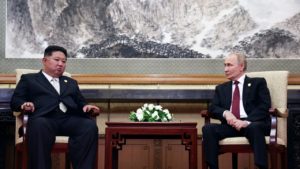
North Korea, Russia reaffirm ties on Korean Liberation Day, as Kim sends Putin more troops

North Korean leader Kim Jong Un reaffirmed the deepening of ties with Russia in a message to President Vladimir Putin as Pyongyang marked the anniversary of independence from Japan’s colonial rule, KCNA state news agency said on Sunday.

Kim was replying to a message of congratulations from Putin marking Saturday's 81st anniversary of Tokyo's surrender in World War Two. The Russian leader said the bond was forged as Soviet soldiers fought against Japan and that cooperation would continue "in all the sectors."

The North Korean leader expressed hope for the future of ties that had “carried forward the history of common struggle for justice and precious traditions of friendship.”

Pyongyang and Moscow have grown closer since the reclusive state began deploying troops and weapons to support Russia’s war against Ukraine in what has been Pyongyang’s most significant involvement in a war since the 1950s.

The Russian ship Pallada arrived at Wonsan port for a goodwill visit on Saturday tied to the liberation anniversary, and was greeted by North Korean provincial officials and Russian embassy staff, KCNA said.

Also on Saturday, South Korean President Lee Jae Myung called for talks with the rival North aimed at peaceful coexistence, telling Seoul's Liberation Day ceremony that the two Koreas need safeguards to prevent conflict and should work to replace their armistice with a "peace regime."

Lee urged dialogue to formally end the 1950-1953 Korean War, which ended in a ceasefire but no peace treaty, and said the talks could explore ways to curb Pyongyang's nuclear program.

Pyongyang has rejected Lee's overtures and criticized US-South Korean military exercises as provocations.

On Thursday, Putin drew Tokyo's condemnation with a visit to an island off Hokkaido, claimed by Japan, that Moscow seized in the days after Japan's 1945 surrender.

Get help now

Send a message with a description of your problem and possible ways of assistance and we will contact you as soon as we consider your problem.