• English
  • Русский

Thirteen dead after tourism aircraft crashes near Nazca Lines in Peru

A small tourist plane crashed on Saturday as it flew over the Nazca Lines archaeological site in southern Peru, killing 13 people, Peru’s government said.

Peru’s Commerce and Tourism Ministry said in a statement that the plane was carrying 11 foreign tourists and two crew members.

The ministry said the plane crashed in the area of Socos, approximately 6 km (4 miles) from the city of Nazca and roughly 19 km (12 miles) from the Nazca Lines site.

The small plane, a Cessna Caravan C-208 aircraft, belonged to the local Peruvian airline Aerodiana and had taken off from the Pisco Airport at roughly 12:10 p.m. local time.

At approximately 1:00 p.m. local time, the crew reported an emergency situation to the control tower at Nazca airport, after which all radio contact was lost, the Transport Ministry said in a statement.

After crashing, the plane caught fire, making any rescue impossible, according to Peruvian broadcaster RPP. Firefighters and municipal police officers were dispatched to extinguish the fire and carry out initial rescue efforts.

The cause of the crash is unknown, and local authorities said they will investigate.

Footage shared on social media showed the smoking wreckage of what appeared to be a small plane on arid plains. Reuters was unable to independently verify the footage.

Aerodiana said in a statement that it "will assess its flight schedule in accordance with the directives of the relevant authorities."

The Nazca Lines, enormous drawings and geometric figures etched into desert plains in the south of the country, are one of Peru’s main tourist destinations, attracting approximately 100,000 annual visitors. Visitors typically view them from small aircraft flying over the site.

Flights over the Nazca Lines departing from the nearby Maria Reiche Airport had been suspended on Friday due to winds exceeding 40 kph (25 mph), which kicked up dust and reduced visibility.

The strong winds forced a small plane carrying two Peruvian tourists and another aircraft carrying six foreign visitors to divert to the Marcona Airport, according to local media.

Homemade explosive carried by woman kills three, wounds at least 21 at Moscow restaurant

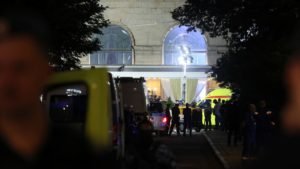
A homemade bomb carried by a woman killed three people and injured at least 21 in an explosion near an upscale restaurant in central Moscow on Saturday evening, the authorities said.

The explosion occurred just before 8:00 p.m. local time close to an Italian restaurant located in one of Moscow's seven Stalin-era skyscrapers at Kudrinkskaya Square, the police said.

Russia's Anti-Terrorism Committee said that an unidentified woman had tried to get into the restaurant but was stopped by a security guard, the state RIA news agency reported.

It said the woman, the security guard and a customer at the Balzi Rossi Italian restaurant had been killed in the blast that followed.

Those injured received wounds of varying seriousness, the police said.

Russia's state RIA news agency released video of heavily armed law enforcement officers at the scene, which had been closed off to the public.

The authorities did not name those killed or injured nor did they say who they thought might have been responsible.

More than four years into a full-scale war with Ukraine, Russia’s FSB security service said earlier this year that authorities would step up protection for high-ranking military officials after a series of assassinations and attempted killings it blamed on Kyiv.

The Kommersant daily newspaper cited its own sources as saying that the bomb had been intended to maim and kill guests who were enjoying themselves on the restaurant’s summer terrace outside.

It suggested that the bomb had been set off by someone else remotely and that the woman carrying it may not have known that it was an explosive device.

The restaurant's website said the venue had been closed on Saturday for a private event.

Clayton will take over as US intelligence chief on Monday, Pulte says

Acting Director of National Intelligence Bill Pulte posted on Saturday that the transition for Jay Clayton to take over the job will take place on Monday.

US Senate Republicans confirmed Clayton’s nomination this week to be the nation’s top spy despite opposition from Democrats following an angry confirmation hearing.

Pulte wrote in a social media post on Saturday that "the DNI transition will take place this coming Monday."

Clayton, who has been the US attorney for the Southern District of New York, will oversee 18 US intelligence agencies.

He steps into a role that was vacated in June when Tulsi Gabbard stepped down after a tenure marked by clashes with congressional Democrats, who accused her of advancing US President Donald Trump’s political agenda and promoting debunked election claims.

Democrats during Clayton’s confirmation hearings criticized him for repeatedly refusing during his testimony to directly acknowledge that Trump lost the 2020 presidential election to Democrat Joe Biden.

Pulte, who is also Trump's Federal Housing Finance Agency director, ordered layoffs of intelligence staff after he assumed the interim intelligence position in June.

His appointment drew criticism from the Democrats for his lack of national security expertise.

Trump walks back agreement to give Ukraine license to produce Patriot missiles

US President Donald Trump walked back his decision to let Ukraine produce its own Patriot interceptors in comments to the Financial Times on Thursday.

Despite previously publicly announcing that he would grant Kyiv the license to the surface-to-air interceptor missiles, Trump told the FT that he was “not sure” about the license and that “we’re looking at it.”

“It’s a very extraordinary weapon, and . . . we have to be a little bit careful of who we license to. We don’t really license equipment,” he told the FT.

Last week, Trump and Ukrainian President Volodymyr Zelensky had a "positive and productive,” meeting ahead of former US senator Lindsey Graham’s funeral.

Before his meeting with Trump, Zelensky said that his “number-one priority is anti-ballistic defense and strategic cooperation with America.”

After the meeting, Zelensky said that Trump had “accepted that he will give us licenses."

That same day, Zelensky met with representatives from Lockheed Martin, which produces the Patriot interceptors, as well as several other ballistic missile systems.

Zelensky wrote on X/Twitter that he discussed “our joint capabilities related to Patriots and other systems.”

“Our teams are already working on specific solutions to move to co-production as quickly as possible and increase our capabilities to protect lives,” he added.

Ukraine has notably become a world leader in drone production and deterrence, but has yet to figure out a way to protect itself from ballistic missiles.

On Friday, Ukraine’s envoy to Washington, Olha Stefanishyna, told reporters that Ukraine was in discussions with the Pentagon about a license to produce Patriot PAC-3 missiles itself, but that process could take 12 months to five years.

Officials from Patriot maker Raytheon Co had already been to Ukraine, and Lockheed Martin Corp, which builds the PAC-3 interceptors for the air defense system, was working to send a team of experts to the country as well, Stefanishyna told an event hosted by the Christian Science Monitor.

"He has an intention to destroy Ukraine, and that's why, you know, we're looking for different capabilities,” she said.

“We have been successful in everything, but so far, for this winter, we need the missiles."

In July, Trump told Zelensky that he would give him the license to make the missiles.

"We're going to give a license to you to make Patriots. That's pretty cool. This way, you can't complain that we're not giving 'em enough," Trump said at a meeting with Zelensky at the NATO summit in Ankara.

"It's a defensive weapon, which I like better than an offensive weapon," Trump said.

Trump then told the FT on Thursday that he was more interested in ending the war in Ukraine than in giving Ukraine the defensive weapon. 

“Very simply put, we want the war in Ukraine with Russia ended,” he said. “I’m not looking for missiles. We’re looking for peace.”

Reuters contributed to this report. 

UNESCO adds 25 new World Heritage Sites including Mount Olympus, Normandy’s D-Day beaches

UNESCO's World Heritage Committee (WHC) added 25 new sites to its list of World Heritage Sites at its 48th session in Busan, South Korea this week, spanning millennia of history and carrying "outstanding universal value" for humanity.

Established under the 1972 World Heritage Convention, a treaty ratified by nearly 200 countries, the designation of “World Heritage Site” includes sites in three categories: cultural sites, natural sites, and mixed sites which combine the two.

While the label carries global weight and often drives up tourism, it does not transfer any legal authority of the site to UNESCO. Rather, host countries maintain full responsibility over the site and its protection in exchange for access to international funding, expertise, and support when needed.

Adding a site to the list is an extensive process. Countries first place candidate sites on a "Tentative List," then submit a formal nomination dossier arguing for the site's value and outlining its protections.

The International Council on Monuments and Sites (ICOMOS) and International Union for Conservation of Nature (IUCN) independently review the submissions before the 21-member WHC makes the final decision at its annual meeting.

“Heritage is a force for cohesion and empowerment,” said UNESCO Director-General Khaled El-Enany in a statement following the conclusion of the 48th WHC meeting. “It carries shared memories, knowledge, and helps restore exchanges after periods of division. It is also a powerful driver of sustainable development, supporting local employment, cultural and creative industries, and responsible tourism.”

So, what are some of the newly designated World Heritage Sites?

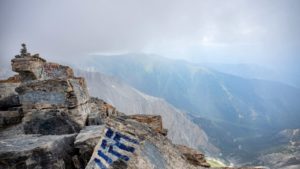
The designation of the wider area of Mount Olympus in Greece as a mixed World Heritage Site was announced by UNESCO on Sunday.

In 1938, Greece named the mountain its first National Park.  In 1981, UNESCO named Mount Olympus a "Biosphere Reserve,” a location where science and culture come together to conserve the natural. The European Union has listed Olympus in the “Significant for Birdlife Regions of European Union,” and in the list of Natura 2000 as an area of special protection and community interest.

Located in northern Greece, Mount Olympus is the highest mountain in the Mediteranian country. Famously, it is the home of the 12 Olympian Gods, the Muses, and the Graces, of the ancient Greeks.

Mount Olympus’s mythological affiliation is not the only reason the mountain was named by UNESCO as a World Heritage site, but – being home to over 1,700 plants (25% of all Greek flora) – its diverse terrain and vegetation played a hand in the designation as well.

Featuring a collection of landforms, including “glacial cirques, limestone cliffs, karstic sinkholes, and olistolith fields,” it also bears evidence of ongoing neotectonic activity, as seen in the Mytikas and Stefani peaks, and the Enipeas gorge.

Greece’s Culture Ministry and Environment and Energy Ministry praised the move in a statement, calling it “one of the most significant international distinctions in the field of protecting cultural and natural heritage.”

The designation of the Beaches of the D-Day Landings, Normandy, 1944, as a World Heritage Site for their "exceptional cultural landscape shaped both by the events of 1944 and by their enduring remembrance,” was announced by UNESCO on Sunday.

Encompassing an area of approximately 80 km of Normandy’s coastline in northern France, the site includes the Utah, Omaha, Gold, Juno, Sword, and Pointe du Hoc beaches.

The six mark the site of the Allied landings at the opening of Operation Overlord against the Nazis during World War II, a decisive stage in the liberation of Europe.

Soldiers participating in the Normandy landings came from the United States, Britain, Canada, Belgium, Norway, Poland, Luxembourg, Greece, Czechoslovakia, New Zealand and Australia. Some 177 French commandos also took part.

In total, 156,115 Allied troops either landed by sea onto the beaches, or were airdropped behind German coastal defenses.

Remains of the Atlantic Wall, including casemates, artillery batteries, and fire‑control posts constructed by the Nazis can be seen on the beaches, as well as traces of the battlefield itself and wartime equipment left behind.

Additionally, the site includes the Normandy American Cemetery and Memorial at Colleville‑sur‑Mer.

“Twenty years of effort to have this memorial site recognized as a heritage of humanity,” French Culture Minister Catherine Pégard wrote on X/Twitter following UNESCO’s announcement. “Pride for Normandy and for France!”

French Ambassador to the United Kingdom Hélène Duchêne echoed Pégard, saying that “the recognition honours France, the United Kingdom and all Allied nations, and reminds us of our shared duty of remembrance.”

The designation of Jordan’s Aqaba Marine Reserve as a World Heritage Site was announced by UNESCO on Saturday.

Established by Jordan as a nature reserve in 1997, it is located at the tip of the Red Sea and covers an area of just under three square kilometers.

The reserve is recognized as the world’s northernmost tropical coral reef system, home to  numerous coral and mesophotic reefs, and seagrass beds, including more than 150 species of hard coral, over 500 species of fish, and 1,000 species of molluscs.

“This achievement underscores Jordan’s commitment to preserving one of the world’s most prominent marine ecosystems and protecting its unique biodiversity for future generations,” said Jordan’s delegation to UNESCO in a post to X, applauding the organization’s decision.

In its own X post, the reserve added that it is proud of the “national achievement” and the inclusion of the site on the World Heritage Site List.

Alamūt Castle and Related Fortifications (ACRF) were designated a World Heritage Site, UNESCO announced on Monday.

The site, which includes Alamūt Castle as well as its associated fortifications of Lambesar, Navizaršāh, Šams Kelāyeh, Qosṭinlār, Širkūh, and Ilān, are located in the Alborz Mountains in northern Iran. 

From the late 11th century CE, Alamūt served as the political, military, and intellectual center of the Nizari Isma'ilism (Nezāri Ismaʿilis) movement until the castle's fall in 1256. Nizari Isma'ilism is the largest segment of the Ismailis, the second largest branch of Shia Islam. The movement is famed for its

Before its fall, Alamūt Castle was home to the Persian branch of the movement's Order of Assassins. The order, founded in 1090, are believed to have conducted several high-profile assassinations across the region during the Crusades.

Its Levant branch was based in Syria's Masyaf Castle.

Iranian opposition outlet Iran International reported earlier this weeek that archaeologist Hamideh Choubak is being hailed as the driving force behind Alamūt’s designation. 

"She devoted 25 years and 16 excavation seasons to the historic fortress," wrote the outlet, sharing footage of Choubak in tears following UNESCO's announcement.

Choubak’s team had unearthed the castle’s prison, observatory, main entrance, and central courtyard, Iran International added, adding that she had documented the site and prepared it for its World Heritage designation.

“I worked for 50 years, and this has been the greatest work of my life,” Choubak shared with Iran International. “It has been a blessing and a fortune that came my way… This has been the greatest achievement of my life.”

The complete list of all 25 new World Heritage sites can be found on UNESCO’s website here.

Reuters contributed to this report.

Ransom notes tied to Nancy Guthrie kidnapping released six months into unsolved case

Two ransom notes purportedly written by kidnappers who abducted the mother of “Today” show co-host Savannah Guthrie were released on Friday, six months after Nancy Guthrie vanished in Arizona, as investigators renewed efforts to identify the culprits.

Copies of the two email messages were posted online by the Pima County Sheriff’s Department with a notice appealing again to members of the public to come forward with information that might help identify the masked prowler caught on video by Nancy Guthrie’s doorbell camera outside her home around the time she went missing.

Both notes, initially delivered to news outlets before being turned over to authorities, have been widely reported in the media, along with some details of their contents, since early in the investigation. But the full texts had not been previously disclosed.

The first, from Monday, February 2 – a day after the 84-year-old Guthrie was reported missing – demanded $4 million to be paid in bitcoin within three days, and warned that if the deadline were missed "the ransom will be increased to $6 million" due by the following Monday, February 9. If the demands went unmet, "she will be killed," it said.

"Your mother is aware of this and her life is in your hands," the note said, adding, "there will be no negotiation. Do not play games; law enforcement will not be able to help you."

The message also contained details meant to authenticate it, saying that Guthrie’s wristwatch had been left on the floor at the foot of her bed, and a backyard floodlight was “destroyed.”

The second note, received on February 6 and addressed to the "Guthrie Family," delivered more grim news.

"We did not fully grasp the seriousness of her physical condition," it begins. "She perished shortly after she was taken. We believe it was heart-related. She is buried in nature now."

It concludes: "We want your family to know this and hope you all can find peace. We are truly sorry."

In the latest of several videos posted to social media since her mother was taken, Savannah Guthrie, longtime co-anchor of the flagship NBC morning news program, appealed to the kidnappers on Monday to "do the right thing" and "tell us where to look for her."

Nancy Guthrie, in frail health with limited mobility, was last seen alive on January 31 at her home in Tucson. She was reported missing on February 1 after a friend alerted family that she did not appear for Sunday church services as expected.

Relatives checking on her found her gone with essential belongings such as her wallet, cellphone, hearing aids and medication left behind. Blood, later confirmed by DNA tests to be hers, was found on the front porch.

Announcing what was expected to be a major break in the case on February 10, the sheriff and FBI released surveillance footage of an armed prowler in a ski mask shown tampering with Guthrie's doorbell camera shortly before she was abducted.

The sheriff's bulletin on Friday said the man in the video, whose identity remains a mystery, "knows what happened to Nancy," and it urged anyone who may know him to come forward.

The ransom notes "reveal distinctive patterns of word choice, syntax and phraseology" that someone close to the author might recognize, the sheriff's message said.

It further suggested the suspect might have exhibited a sudden "change in mood," behavior or daily routine around the time of the kidnapping, and may have abruptly altered his appearance, including changes in hairstyle and facial hair.

Turkish national charged by US for funding Hamas using sham humanitarian charity

Turkish national Mohammad Yousef Hasna was charged with conspiring to provide material support for Hamas under the guise of humanitarian fundraising and other terrorism financing offenses by the US Department of Justice on Friday.

Hasna, also known as “Orhan Korkmaz” and “Abu al-Baraa,” was arrested in the UK, where he allegedly acted as the global director of a registered charity, and ordered detained until he is extradited to face trial in the US.

According to the DOJ’s complaint against Hasna, he provided financing and commodities to Hamas through what was identified as a Sham Charity and worked closely with Hamas terrorists, including senior Hamas terrorist Ghazi Hamad. 

Since at least 2023, Hasna coordinated with Hamad in a number of ways, including arranging deliveries of cash to Hamad, procuring supplies for transport into the Gaza Strip, transporting materials into Gaza from Egypt, and distributing the supplies to warehouses controlled by the Sham Charity and Hamas.

Hasna and Hamas also worked together to conceal where the materials were being delivered and stored, taking pictures and videos of the supplies for the Sham Charity that omitted warehouse signage indicating their location and control.

FBI Counterterrorism Division Assistant Director Jarod Brown stated that in Hasna’s coordination with Hamas, he “knew the resources were going to that group rather than to needy non-combatants."

“The accused allegedly used a purported humanitarian aid organization to raise funds and provide financing and supplies to Hamas, a ruthless international terrorist organization,” Brown stated.

According to the US Attorney’s Office of the Southern District of New York, following Hamas’s October 7 massacre against Israel, Hasna’s Sham Charity disclosed to UK authorities that its gross income nearly doubled.

In 2023, the Sham Charity disclosed a gross income of $41.8 million. In 2024, that figure rose to around $81.56 million.

In the 2025 fiscal year, the Sham Charity reported spending approximately $91 million on allegedly charitable activities.

“The money that flows from sham charities like the one described in the complaint fuels Hamas’s terrorist activities, including the atrocities the group committed on October 7,” said US National Security Assistant Attorney-General John Eisenberg. “Hamas cannot function without injections of money through its illicit financial networks."

Hasna is accused of funneling millions of dollars in aid to Hamas through his Sham Charity and was charged with conspiring to provide material support to Hamas, conspiring to finance terrorism, and financing terrorism. Each charge carries a maximum sentence of 20 years in prison, according to the DOJ.

The investigation that led to Hasna’s arrest was aided by UK law enforcement and the Shin Bet (Israel Security Agency).

Spain says migrants are returning from Ceuta after 57 die in border rush

Spain said on Friday it had reversed a huge rush of migrants into a Spanish enclave in North Africa, with most of the more than 50,000 people who had crossed the border by land and sea already heading back voluntarily.

The Spanish government's representative in Ceuta said 57 bodies had been recovered on the Spanish side of the border and that there could be additional casualties on the Moroccan side. It said some drowned and some were crushed while trying to climb the breakwater that holds the border fence.

Spain's Interior Ministry said around 50,000 people had crossed the border since Thursday morning, and estimated that 48,300 had returned by 6 p.m. on Friday. Juan Jesus Vivas, head of Ceuta's local government, said as many as 60,000 people had pushed across over the past couple of days.

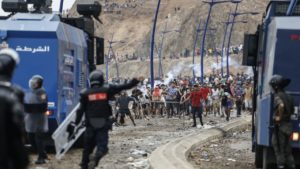
Moroccan forces beat back crowds with batons and tear gas at the gates to Ceuta, trying to prevent more from entering the tiny Spanish territory that juts on a spit of sandy land into the Mediterranean from Morocco.

The rush on the border caused division in Europe, where leaders of fellow EU states called for Spain to ensure that the incident was contained.

Italy said it was suspending the European Union’s border-free Schengen arrangements with Spain, a measure set to affect people traveling by plane or boat between the two countries. Madrid said the move violated EU treaties.

Reuters at the enclave’s border saw Moroccan police in riot gear using tear gas to disperse some of the people amassed near the fences. Water cannon trucks were deployed, and the charred remains of a bus and seven cars could be seen from clashes with the crowds.

On the other side, Spanish military vehicles lined up along sections of the border as dozens of migrants watched from a hilltop in Morocco, unable to cross.

Several hundred people could be seen returning to Morocco through border posts and holes in the fence, with some saying they could not find food or shelter in Ceuta.

“Honestly, I don’t even know why I came, and now I’m going back,” a young Moroccan man, who said he was from Tangier, told Reuters. “I haven’t eaten since lunch yesterday, even though I brought some money with me … What we’re doing is neither good nor enjoyable.”

Ayman, a 20-year-old hairdresser from the port city of Larache who only gave one name, told Reuters he had crossed on Wednesday after a five-hour swim.

"There was no food inside Ceuta and we were kicked out badly by the (Spanish) army," he said.

Spanish Prime Minister Pedro Sanchez traveled to Ceuta on Friday, where he was greeted with insults from protesters. He called the mass crossing “a violation of Spain’s territorial sovereignty” and said authorities were speeding up the repatriation of those who had entered illegally, with full cooperation from Morocco.

Ceuta and ‌Melilla, Spanish autonomous cities in northern Morocco, have the European Union's only land borders with Africa. Both periodically experience surges in attempted crossings by migrants seeking to reach ​Europe, but the scale of Thursday's rush appeared unprecedented.

Right-wing parties around the continent blamed the incident on Spain's comparatively lax migration policies, including an amnesty granted to hundreds of thousands of unauthorized migrants this year.

Spain summoned the Italian ambassador to protest earlier comments by Italian Foreign Minister Antonio Tajani, who claimed Spain's amnesty policy had "encouraged human trafficking."

US President Donald Trump, a long-time critic of Spain's Socialist-led government, told a cabinet meeting the Ceuta crossings "look like an invasion," adding: "That same thing's going to happen to us if the Republicans don't get elected, except worse," referring to upcoming midterm elections.

The State Department on X/Twitter pointed the blame squarely at the Spanish government, saying the incident was a direct result of its migration policies. "We are considering actions to defend Americans at home and abroad from this threat and stand ready to assist other European allies considering similar options," it said.

"This unacceptable incident is the direct result of the Spanish Government's deliberate efforts to enable and facilitate mass illegal migration into Europe.

Meanwhile, French Interior Minister Laurent Nunez said police presence on the Spanish border would be quintupled by Saturday, while reinforcing aerial surveillance and patrols on trains.

EU countries are normally barred from conducting checks at internal frontiers of the bloc's Schengen zone, though checks can be reimposed temporarily under exceptional circumstances.

In a post on X/Twitter, Spain's Guardia Civil police association AUGC said there had been too few police in place to monitor the fence during the surge on Thursday, making them unable to stop the rush.

Territorial Policy Minister Angel Victor Torres said that among factors contributing to the surge may have been a ruling by Spain's Supreme Court earlier this month that migrants intercepted at sea while attempting to reach Ceuta or Melilla cannot be summarily rejected at the border. Experts say that still does not prevent their expulsion.

On the Moroccan side of the border, thousands of migrants streamed into the town of Fnideq overnight despite a reinforced deployment of security that foiled most attempts to cross. Some began leaving again later on Friday.

Although the crossing appeared blocked, groups moved along the coast seeking routes around the fence.

"I was late," said Brahim, 32, who gave only one name. He said he had arrived from Tangier hoping to cross through the gate but found it effectively shut.

Pakistan aims to double US trade to $20 billion in five years

Pakistan wants to increase its bilateral trade with the United States to $20 billion over the next five years. The country remains an important importer of US cotton, soybeans, and energy products, while its growing demand for advanced technology, machinery, and capital goods offers significant opportunities for American businesses.  

For more stories from The Media Line go to themedialine.org

Deputy Prime Minister and Foreign Minister Ishaq Dar expressed these views while addressing a delegation of US Congressmen Rep. Ryan Zinke (Montana) and Rep. Michael Baumgartner (Washington), along with American business leaders in Islamabad on Tuesday.

According to the state broadcaster Radio Pakistan, Dar has reaffirmed Pakistan’s commitment to further strengthening its strategic and economic partnership with the United States through enhanced trade, investment, and parliamentary engagement.  

The two congressmen recently held meetings with Pakistan's military leadership, including Field Marshal Asim Munir, as well as Dar, to discuss regional security, defense cooperation, and ways to strengthen bilateral economic and trade ties.

Highlighting improving economic indicators and ongoing structural reforms, Dar presented Pakistan as an appealing investment destination with vast potential in artificial intelligence, critical minerals, energy, manufacturing, and defense.

"Trade between Pakistan and the US reached $9.4 billion in the last fiscal year," he said. "Although encouraging, we are confident that by capitalizing on the complementary strengths of our economies, we can double this trade to $20 billion in the next five years.

Welcoming the US business delegation, Dar said the presence of more than 80 American companies in Pakistan reflects confidence in the country's market and long-term economic prospects.

He invited US investors to explore opportunities in technology, critical minerals, energy, defense, manufacturing, agriculture, and information technology, noting that Pakistan's improving macroeconomic outlook, structural reforms, and investment facilitation mechanisms have created a more business-friendly environment.

He also appreciated the US EXIM Bank's $1.25 billion in financing for the Reko Diq project, describing it as a strong vote of confidence in Pakistan's economic future.

Dar said the Pakistan-US relationship continues to gain momentum under the leadership of Prime Minister Shehbaz Sharif and US President Donald Trump, with frequent high-level engagements reinforcing mutual trust, respect, and cooperation. Dar’s remarks come as Pakistan actively seeks to deepen economic ties with the United States and attract much-needed foreign direct investment.  

Bolstered by emerging signs of macroeconomic stability following a crucial $7 billion bailout package secured from the International Monetary Fund (IMF) last year, Islamabad is seeking to shift its traditional relationship with Washington from a primarily security-focused one to a durable, trade-driven partnership.

By capitalizing on recent fiscal discipline, currency stabilization, and structural reforms mandated by the IMF program, Pakistani officials are eager to project the country as a viable, secure, and lucrative hub for American businesses in key sectors such as technology, energy, and mining.

Musical band Massive Attack members barred from Singapore after displaying Palestinian flag

Two members of Massive Attack were issued with stern warnings and barred from re-entering Singapore after the British band ended their performance on Wednesday with a display of the Palestinian flag, according to local media reports.

Authorities said the band were investigated for their “actions of support for a political cause and unfurling of a foreign flag,” during the band’s concert, reports said.

The Infocomm Media Development Authority also said it is investigating the possible breach of a number of license conditions and will take "necessary action" when investigations are completed, reports added.

Singapore does not allow the public display of foreign national emblems without a permit or exemption, and the Palestinian flag is especially sensitive given the war in Gaza and Singapore’s Muslim population.

In 2023, the home affairs ministry said: "The ongoing Israel-Hamas conflict is an emotive issue. We would like to advise against the public display and wearing of articles in relation to the conflict, given the heightened sensitivities."

"The peace and harmony between different races and religions in Singapore should not be taken for granted, and we must not let events happening externally affect this peace and harmony we have in Singapore."

Singapore's resident population is 74% Chinese, 13.6% Malay, and 9% Indian, with 3.3% classified as others. Around 15% are Muslim.

Massive Attack, formed in Bristol in the west of England in 1988, are known for their outspoken political stances, with videos during their concert highlighting conflicts from the U.S.-Israeli war on Iran, to Sudan, Gaza and Ukraine.

Neither the concert organizer Lushington nor the band immediately responded to a request for comment.

Get help now

Send a message with a description of your problem and possible ways of assistance and we will contact you as soon as we consider your problem.