• English
  • Русский

Drone strikes, intelligence chief’s killing expose Libya’s fragile balance – analysis

Drone attacks on energy facilities in western Libya and the assassination of a senior intelligence official in the east have renewed fears of instability as Libyan factions maneuver ahead of possible political negotiations.

For more stories from The Media Line go to themedialine.org

No evidence has emerged connecting the two sets of events, and no group has claimed responsibility for either. Their timing has nonetheless raised questions about whether Libya faces another brief outbreak of violence or a broader contest for influence.

Maj.-Gen. Fawzi al-Mansouri, head of military intelligence for Khalifa Haftar’s eastern-based forces, was killed in Benghazi on Monday night, August 10, when an explosive device detonated at his vehicle in the Hawari district, according to security officials and the eastern General Command.

Al-Mansouri was buried the following day at a funeral attended by senior military figures, including Saddam Haftar, one of Khalifa Haftar’s sons. A security committee has opened an investigation, but authorities have not publicly identified a suspect or motive.

The assassination eliminated one of the most senior officials in an eastern security establishment that has portrayed Benghazi and much of eastern Libya as having left behind the instability of earlier years.

Hundreds of kilometers to the west, attacks were hitting some of the country’s most important energy facilities.

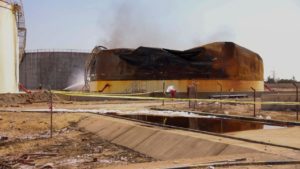
Drone strikes began targeting facilities in Zawiya on August 9. The following night, a drone hit a gasoline-storage tank at the Zawiya oil complex, west of Tripoli, causing a major fire and the tank’s collapse. The tank held approximately 4.5 million liters of gasoline when it was struck, according to Libya’s National Oil Corporation.

Another drone landed near a second tank without causing reported casualties or damage. Further attacks continued into August 11.

The National Oil Corporation said firefighters had contained the blazes and that the refinery itself was not damaged, although production was briefly disrupted. It warned that more attacks could force it to suspend operations.

The complex includes Libya’s largest operating refinery, which can process approximately 120,000 barrels per day. It is connected to the Sharara oil field and plays a central role in the country’s energy production and fuel-distribution network.

Libyan Prime Minister Abdul Hamid Dbeibah, who heads the internationally recognized Government of National Unity in Tripoli, condemned the strikes as organized crime and promised to hold those responsible accountable.

Another drone struck the South Zawiya electricity substation on August 12, setting it ablaze and causing widespread outages. Libya’s state-run General Electricity Company said more than 700 megawatts of the nearby power plant’s 1,300-megawatt capacity remained unavailable.

US energy company GE suspended work at the power station and withdrew its technical teams because of the security situation.

The attackers and their objectives remain unknown. Zawiya is divided among armed groups with shifting alliances, and tensions have grown between Dbeibah’s government and forces associated with Mohamed Bahroun, a powerful commander in the city.

Libya has been divided between rival centers of authority for more than a decade. Dbeibah’s government operates from Tripoli, while authorities backed by Haftar’s forces control the east. A 2020 ceasefire ended the last major nationwide war but failed to produce unified political, military, or security institutions.

The latest violence comes as Libyan leaders and foreign governments seek arrangements that could narrow the east-west divide.

Misbah Omar, a Libya-based analyst at the Institute for Integrated Transitions and a member of the Mediterranean Platform, said the attacks could be part of a larger contest, although no wider pattern has yet been established.

“If this assessment is correct, what we are witnessing may represent an initial phase in the restructuring of Libya’s political and security landscape – one aimed at allowing the main actors to consolidate or redefine their respective spheres of influence before moving toward a clearer political process,” Omar told The Media Line.

Zawiya is particularly important in any contest over western Libya. The city sits west of Tripoli at the junction of armed influence, energy infrastructure, migration routes, and economic networks.

The attacks raise the possibility that armed factions or their opponents are shifting their focus from direct clashes to the resources and supply systems that sustain military power.

“Such actions would represent a significant shift in the nature of the confrontation,” Omar said. “Rather than focusing exclusively on the armed formations themselves, pressure could increasingly be directed toward the economic and logistical networks that sustain their influence and operational capacity.”

Potential targets could include infrastructure, revenue sources, supply routes, and other assets that help armed groups maintain their position, he added.

Ibrahim Mousa Said Grada, a former Libyan ambassador to Sweden and former UN adviser, also described Zawiya as central to the struggle over political power and economic resources.

“This happened in Zawiya, a city that deserves to be described as afflicted and targeted because it has become a meeting point for the contradictions of politics, conflicts of interest, and disputes over the division of power and resources in Libya,” Grada told The Media Line.

The violence coincides with renewed US efforts to encourage cooperation between Libya’s rival authorities.

Massad Boulos, senior adviser to US President Donald Trump for Arab and African affairs, has promoted an initiative focused on institutional reunification and economic cooperation. He has met Haftar, Dbeibah, and other political and military figures across Libya.

Published accounts describe the initiative as an effort to reach agreements between Haftar’s eastern authorities and Dbeibah’s Tripoli-based government, with energy investment and economic development offered as incentives.

The plan remains controversial, and many of its details have not been made public. Critics warn that a power-sharing agreement could preserve the authority of Libya’s current leaders and armed factions rather than build representative national institutions.

Omar said the US approach seemed to favor a series of limited agreements rather than a comprehensive settlement.

“If this trajectory continues, the initiative could enter a more practical phase during the final quarter of this year and the beginning of next year, operating along two parallel tracks: economic and political, supported by corresponding security arrangements on the ground,” he said.

Grada was less optimistic about its immediate prospects.

“The Boulos initiative ‘appears’ to have been placed in a freezer during this scorching summer, so that it does not die or become buried altogether,” he said.

The recent attacks do not show that Libya’s factions have agreed on a new division of power. They could instead represent attempts by competing groups to improve their positions before negotiations, whose timing and structure remain unclear.

Al-Mansouri’s assassination creates another problem for the east. Grada said the loss of its military intelligence chief came at a sensitive time for Libya’s divided security services.

“At the same time, the absence of the head of military intelligence for the eastern Libyan forces coincides with the continuing dispute over the leadership of the General Intelligence Service, or external security apparatus,” Grada said. “This means an intelligence vacuum and state of confusion at a particularly dark and sensitive moment domestically and during a highly unstable and critical international environment.”

Foreign involvement adds to the uncertainty. Russia, Turkey, the US, European powers, and regional governments retain varying degrees of political, economic, and security influence in Libya.

“There is an increasing possibility that Libya could be transformed into an arena for proxy warfare between intelligence services and their military and media arms, as international and regional conflicts and rivalries expand and deepen,” Grada said.

The latest violence does not necessarily mean that Libya is heading back to nationwide war. Omar said a series of limited moves intended to change the balance of power was more likely than an immediate, large-scale confrontation.

“However, these developments should not necessarily be interpreted as evidence of an imminent comprehensive military confrontation,” he said. “A more plausible scenario may be a series of calibrated and limited moves designed to alter the balance of power gradually, while leaving room for negotiations and political accommodation.”

The next political agreement may depend as much on events outside formal negotiations as on what happens at the table. Control of territory, energy assets, and security institutions will help determine what Libya’s competing factions are willing – and able – to accept.

The Zawiya strikes and al-Mansouri’s assassination do not prove that anyone is carrying out a coordinated plan to redraw Libya’s balance of power. They do show how quickly an attack on an oil tank, power station, or security chief can unsettle a country whose rival authorities have never fully resolved the conflict between them.

UK Dept Ed. reviewing Muslim schools run by Al-Khair Foundation following reports of Hamas ties

The UK's Department of Education (DfE) is assessing information regarding four Muslim independent schools after the Charity Commission opened a statutory inquiry into the Al-Khair Foundation, the organization that runs the schools.

As reported by the The Jerusalem Post on August 9, the UK Charity Commission is investigating the prominent Muslim-registered charity Al-Khair Foundation following reports of alleged Hamas connections.

Al-Khair was set up to advance religion, promote education, support social welfare, build religious harmony, and offer relief to victims of disasters.

However, the Commission said it received a complaint alleging the charity and its partners had connections to Hamas and had also funded Hamas.

The regulator immediately started examining the serious concerns raised and gathered more information to inform its assessment. The Commission has now escalated its engagement to a statutory inquiry.

This follows the arrest of Mohammad Yousef Hasna, an individual employed by Al-Khair Foundation, in the UK last week. Hasna was extradited to the US and charged with conspiring to provide material support to Hamas.

This prompted UK Lawyers for Israel (UKFLI) to send a report to the DfE's Counter-Extremism Division on 10 July 2026, detailing Al-Khair’s links to the Hamas terrorist group and raising concerns about safeguarding, extremism, and compliance with the Prevent duty at schools operated by the charity.

The Post viewed correspondence between UKFLI and the DfE regarding the Al Khair Foundation. DfE said it is “continuing to work with other government departments and agencies to assess all the information that has been provided to us and determine next steps”

The four schools run by Al Khair Foundation are Al-Khair Preparatory School in Croydon; Al-Khair Preparatory School in Oldbury, Birmingham; and Al-Khair Secondary Schools for Boys and Girls in Croydon.  Over 550 children attend the four schools. The annual school fees are £5468 for the Croydon schools and £3600 for the Birmingham school.

UKLFI's letter to the DfE warned that the schools could be exposed to safeguarding and Prevent-related risks arising from Al-Khair’s employment of individuals allegedly linked to proscribed terrorist organizations. UKLFI's investigation found that at least two people employed by Al-Khair Foundation had been identified as Hamas operatives, while another employee had significant links with Hamas figures.

Schools are subject to the statutory Prevent duty, requiring them to assess the risk of pupils being drawn into terrorism, challenge extremist narratives and manage potentially harmful external influences. UKLFI said the evidence it had gathered justified examination of whether those safeguards were operating effectively at the Al-Khair schools.

A UKLFI spokesperson said, "The allegations concerning Al-Khair Foundation are extremely serious in themselves, but they become still more concerning when an organization facing such allegations is also responsible for the education and safeguarding of children."

"UKLFI alerted the Department to these concerns because schools must have robust procedures to protect pupils from extremist influence and from being drawn into support for terrorism. We hope the Department will now examine carefully the governance of all four schools, their relationships with the Foundation and its personnel, and whether their safeguarding and Prevent obligations have been properly discharged.

"The Charity Commission's statutory inquiry and the separate criminal allegations now being pursued by the US authorities underline why these concerns required urgent investigation."

Could double jeopardy end Luigi Mangione’s New York state murder case? – explainer

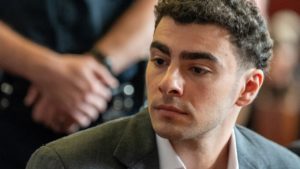
On Friday, Luigi Mangione pleaded guilty to federal stalking charges and admitted to killing UnitedHealthcare CEO Brian Thompson in 2024.

But Mangione’s trial is far from over. He still faces state charges in New York for second-degree murder and other weapons-related charges.

On Friday, Mangione acknowledged that his guilty plea could result in two lifetime prison sentences. If he is charged with second-degree murder and weapons and forgery charges in his state trial, he could have, at maximum, an additional life sentence added to his charges.

Mangione will be sentenced on December 18. Until then, his defense and prosecutors will jockey over his state charges.

Within the hour of his plea deal, Mangione’s lawyers formally requested that the state case be dropped, as it could arguably amount to double jeopardy.

Double Jeopardy is a clause in the US Constitution’s Fifth Amendment that says individuals cannot be sentenced multiple times for the same offense.

Mangione’s lawyers, led by Karen Friedman Agnifilo, argue that the state and federal authorities worked together to maximize his chance of conviction.

"New York law does not permit a person to be prosecuted and punished twice for the exact same crime under a statute that covers successive prosecutions; it's also known as the double jeopardy law," Agnifilo said.

Notably, because Mangione faces both federal and state charges, both sovereign entities get their shot at prosecuting him. However, Agnifilo and her team argue that federal and state prosecutors did not work separately, which could violate Mangione’s due process rights under the Constitution.

“There is no dispute that the state and federal prosecutors each charged the identical murder,” they wrote.

"Despite this being a single, isolated event, Mr. Mangione has been unfairly treated since the outset in every way and has successfully fought off terrorism charges and the death penalty, while also fighting at the same time two simultaneous prosecutions in two jurisdictions that are trying to punish him twice for the exact conduct," Agnifilo told reporters after the plea was entered.

"Today's guilty plea triggers the [double jeopardy] statute, and we just filed our motion in state court explaining why the state charges must be dismissed under New York's double jeopardy protections.”

However, the Manhattan District Attorney’s office said it had been working to convict Mangione for years, signaling that it would fight the defense’s double jeopardy argument.

“Since December 2024, the Manhattan D.A.’s Office has been tirelessly preparing to pursue a trial conviction in New York State Supreme Court for the alleged cold-blooded murder of Brian Thompson,” a spokesperson Manhattan DA Alvin Bragg said in a statement.

"We are encouraged that Mr. Thompson's family received a measure of accountability today. While federal sentencing is pending, we are prepared to litigate the defense motions. The Manhattan D.A.'s Office remains committed to seeking justice for Mr. Thompson and his family."

The Manhattan District Attorney’s Office could potentially keep the state charges against Mangione going if prosecutors successfully argue that the state’s case seeks to address a different kind of harm than the federal case.

Additionally, if the prosecution succeeds in its argument that the cases are meant to address different levels of harm, then Mangione’s admission on Friday would be admissible in state court.

Manhattan’s lead Federal Prosecutor, James McDonald, noted on Friday that his office was free to seek the maximum penalty for Mangione.

“While the defendant pled guilty, our office does not have a plea agreement with him,” McDonald said.

"There are no accommodations or concessions, and we are free to seek the maximum penalty under the law.”

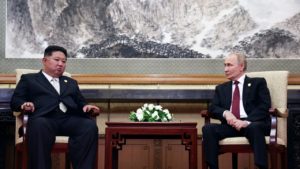
North Korea, Russia reaffirm ties on Korean Liberation Day, as Kim sends Putin more troops

North Korean leader Kim Jong Un reaffirmed the deepening of ties with Russia in a message to President Vladimir Putin as Pyongyang marked the anniversary of independence from Japan’s colonial rule, KCNA state news agency said on Sunday.

Kim was replying to a message of congratulations from Putin marking Saturday's 81st anniversary of Tokyo's surrender in World War Two. The Russian leader said the bond was forged as Soviet soldiers fought against Japan and that cooperation would continue "in all the sectors."

The North Korean leader expressed hope for the future of ties that had “carried forward the history of common struggle for justice and precious traditions of friendship.”

Pyongyang and Moscow have grown closer since the reclusive state began deploying troops and weapons to support Russia’s war against Ukraine in what has been Pyongyang’s most significant involvement in a war since the 1950s.

The Russian ship Pallada arrived at Wonsan port for a goodwill visit on Saturday tied to the liberation anniversary, and was greeted by North Korean provincial officials and Russian embassy staff, KCNA said.

Also on Saturday, South Korean President Lee Jae Myung called for talks with the rival North aimed at peaceful coexistence, telling Seoul's Liberation Day ceremony that the two Koreas need safeguards to prevent conflict and should work to replace their armistice with a "peace regime."

Lee urged dialogue to formally end the 1950-1953 Korean War, which ended in a ceasefire but no peace treaty, and said the talks could explore ways to curb Pyongyang's nuclear program.

Pyongyang has rejected Lee's overtures and criticized US-South Korean military exercises as provocations.

On Thursday, Putin drew Tokyo's condemnation with a visit to an island off Hokkaido, claimed by Japan, that Moscow seized in the days after Japan's 1945 surrender.

At least 10 injured, 12 killed after Polish bus overturned into ditch in Hungary

A dozen people were killed and at least 10 injured after a Polish bus overturned at night on a motorway in eastern Hungary, Hungarian Prime Minister Peter Magyar said on Sunday morning in a Facebook post.

The bus ran into a ditch and tipped over early on Sunday near the town of Mezokeresztes in eastern Hungary, police said, adding that the bus was heading towards the city of Nyíregyháza on the motorway when the accident happened.

State news agency MTI said there were 57 passengers and two drivers on the bus.

“A Polish-registered bus traveling on the M3 motorway towards Nyíregyháza… veered off the straight stretch of road into a ditch and overturned. Preliminary information suggests the driver likely fell asleep,” police said on their website.

Twelve people lost their lives, and several others were injured in the accident, police said, adding that they were taking the bus driver into custody.

The injured have been taken to hospital.

Israeli aid delegation begins work in Colombia following deadly earthquake

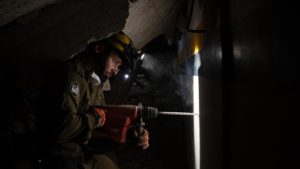
An IDF humanitarian delegation, the “Alliance of Brothers,” began operating in Colombia on Saturday after arriving in the country following a major earthquake in the region.

The 80-person delegation, led by the Home Front Command in cooperation with the Defense Ministry and Foreign Affairs Ministry, was sent after Colombian President Abelardo de la Espriella requested assistance from Israel.

Currently, Colombia has requested rescue teams from only four countries: the US, Ecuador, El Salvador, and Israel.

They are working in coordination with local professionals and officials at multiple impacted sites, focusing on two major sites by assisting in locating and rescuing people trapped by rubble.

One such site is the city’s university hospital, which experienced considerable damage. Home Front Command engineers are conducting search and rescue operations while attempting to restore the damaged medical wing’s operation.

IDF Home Front Command forces operating at impact sites in Cali, Colombia, August 14, 2026. (credit: IDF Spokesperson’s Unit)

Mapping efforts and building assessments have begun in order to establish plans and priorities for the ongoing response efforts.

The delegation is also assisting in establishing data management systems in order to manage situational assessments and decision-making to help navigate the complex process.

Colombian authorities confirmed Friday morning that around 400 people remain missing nearly four days after the quake, whose epicenter was in the vulnerable Chocó department on the country’s Pacific coast.

Hundreds have been killed in the earthquake and its resulting damage, and over 4,000 people have so far been documented to have injuries.

Ariella Roitman contributed to this report.

Steve Witkoff’s grandson born on 15th anniversary of son Andrew’s death

Alex Witkoff, son of US President Donald Trump’s special envoy, Steve Witkoff, marked the 15th anniversary of his brother Andrew’s death on Saturday by sharing that his newborn nephew was born on the same date and named in Andrew’s memory, a coincidence he described as “bashert,” or “meant to be.”

"Exactly 15 years ago, we unexpectedly lost my beloved brother Andrew," Witkoff wrote, reflecting on his brother's death. On the anniversary of Andrew's death, the family welcomed a new life when his brother Zach Witkoff and Zach's wife, Sophie, had a son named Theodore Andrew in memory of his late uncle.

The timing carried particular significance because that day was the only one on which the couple’s doctor was available to deliver the baby. “In Judaism, we call this ‘bashert,’ meant to be,” Witkoff wrote.

For the Witkoff family, a day long associated with tragedy has now taken on new meaning. "A day forever marked by unimaginable loss now carries with it new life, joy, and hope. Theodore will carry forward Andrew's name, memory, and spirit," Witkoff wrote.

Andrew Witkoff died of an opioid overdose in 2011 at age 22. Steve Witkoff previously spoke about the loss at a conference on the opioid epidemic organized by First Lady Melania Trump.

"After my son died, I found myself clinging to his memory, even his possessions. His student ID is in my pocket now, I have worn his ring since he died, I came here today wearing his watch, I kept his guitar, and I thought I would keep it forever, but I gave it to a dear friend of mine, a dear friend of Andrew's, and a music fan like him, Donald Trump," he said.

Theodore is Steve Witkoff's second grandchild; the first is nearly-two-year-old Don James Witkoff, born to Zach Witkoff in December 2024. He is named after Donald Trump, a fact that both Trump and Witkoff publicized online shortly after Don's birth.

"Congratulations to Zach and Sophi Witkoff on the birth of their son, Don James Witkoff (DJW), named after me (Thank you!). I wish them the best today, the day of DJW’s Bris," Trump wrote on Truth Social at the time. "Don will have a great, beautiful, and successful life. This will be, because of him, a very important date as the years go by!"

"Thank you Mr. President," Zach Witkoff wrote in a response on Twitter/X. "It is an honor to name our son after the greatest President of all time and all that you stand for."

Jerusalem Post Staff contributed to this report.

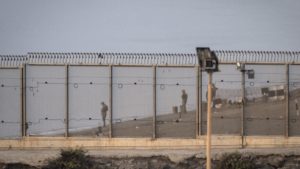
Morocco arrests 111 as migrants attempt to reach Spain’s North African enclave of Ceuta

Moroccan police arrested at least 111 people on Saturday as they tried to enter Spain’s North African enclave of Ceuta, amid tightened security on both sides of the border after social media posts called for another mass migrant crossing.

The attempted crossing came two weeks after more than 72,000 migrants surged into Ceuta, sparking tensions within the European Union and fueling anti-immigration rhetoric among far-right parties worldwide. At least 96 people died in the attempt to reach European soil.

A source in Morocco’s Interior Ministry told Reuters those detained included 109 migrants from sub-Saharan Africa and two Moroccan citizens arrested in or around Fnideq, the Moroccan city opposite Ceuta.

According to Spanish news agency EFE, Moroccan police used tear gas to disperse groups of migrants gathered on hills about 3 km (1.9 miles) from the border. Reuters later saw hundreds of police officers, some in riot gear and others in plain clothes, returning from the hills outside Fnideq.

EFE and Spanish state broadcaster TVE said Morocco's Interior Ministry ordered their journalists to leave Fnideq immediately, without providing an explanation.

In Ceuta, Spanish soldiers guarded supermarkets while police heavily patrolled the enclave's main streets. The city was calmer than in the days after the deadly crossing attempt on July 30.

Madrid has since installed a maritime barrier and deployed more than 500 additional police from mainland Spain, raising the total in Ceuta to more than 1,600. The Interior Ministry said the reinforcements would remain for as long as needed.

"We'll continue to deploy whatever personnel are necessary to restore normality as soon as possible and prevent events like those of July 30 from happening again," Interior Minister Fernando Grande-Marlaska said on Thursday.

About 5,000 migrants remained in Ceuta, the minister said. Reuters saw hundreds sheltering from scorching heat under makeshift bamboo shelters on the urban beach of El Trampolin.

Grande-Marlaska said migrants who entered irregularly would not be allowed to stay in the enclave, travel to mainland Spain or obtain legal status, except in rare cases involving extreme vulnerability. Those without a right to remain would be returned to Morocco, he said.

Earlier this week, Rabat said it was monitoring "the circulation of social media posts and messages of unknown origin" calling for a mass crossing on August 15, warning it would prosecute organizers and participants.

A Reuters witness saw reinforced security near the border, including police vans with wire shields and road checkpoints. Local media reported similar measures near Spain’s other North African enclave, Melilla.

Authorities prevented several groups from boarding trains and buses to northern Morocco in cities such as Casablanca, Fez and Kenitra. However, witnesses told Reuters that some migrants from sub-Saharan Africa were bypassing security checkpoints by taking mountain routes towards Fnideq.

One witness said the schools in Fnideq had been turned into accommodation for security forces deployed near the border.

Many of the young people who entered Ceuta on July 30 were fishing, swimming or washing at Tarajal beach on Friday.

Driss Sadik, a 22-year-old from Fez who said he swam for five hours to reach Ceuta, urged others not to follow his example.

“The important thing I would advise people trying to cross: Don’t cross now, my brothers. You’re only going to suffer,” he told Reuters.

The warning was echoed by Adil Jamil, 17.

"Those who enter aren't going to benefit from anything. There will just be more and more of us, and they won't find a solution for all," he said.

Jamil said that the mass border crossings were "planned by the people" who pick a date, gather in Fnideq, and cross together to find strength in numbers.

"If I had stayed with my parents, I would've died slowly. But if I risk my life, arrive and build my future … it will be better," he said.

Five shot outside Virginia State University residence halls, one critically wounded

Five people were shot outside residence halls at Virginia State University early Saturday, leaving one person critically wounded and prompting a campus lockdown, Chesterfield County Police said.

Police responded to reports of a shooting at approximately 1:28 a.m. local time and found five people suffering from gunshot wounds outside the university’s residence halls.

All five victims were transported to area hospitals. One person was in critical condition, while the other four sustained injuries that were not considered life-threatening, according to police.

Authorities were investigating multiple suspects in connection with the shooting, according to reports. The identities of the victims and their connections to the university were not immediately clear.

The university initially ordered a lockdown as law enforcement responded to the shooting. The lockdown was later lifted, although a significant police presence remained on campus as the investigation continued.

The shooting occurred near the university's Quad Annexes in the area of Boisseau Street. Chesterfield County Police were leading the investigation, with university police and other law enforcement agencies assisting.

Virginia State University is a historically Black university founded in 1882 and located in Ettrick, Virginia, less than 25 miles south of Richmond. The shooting occurred shortly before the beginning of the new academic year.

Trump, Hegseth deny concerns of poor conditions, low morale reported aboard USS Abraham Lincoln

US President Donald Trump and US Secretary of Defense Pete Hegseth downplayed concerns regarding the well-being of sailors deployed on the USS Abraham Lincoln aircraft carrier on Friday after reports claimed that distressed service members had tried to jump overboard due to poor conditions.

Trump asserted that the over-260-day deployment was “not nearly long enough” when asked by reporters if he believed the deployment had gone on too long.

“That ship is moving right now or very shortly, and it's being replaced with another very similar ship,” he continued, speaking to the media before boarding Air Force One on Friday.

Hegseth took to social media to criticize the allegations of low morale and poor conditions on the USS Abraham Lincoln, labelling outlets that have reported on the matter as “fake, America-hating news.”

“The reckless and shameless ‘American’ media completely and intentionally misrepresent the USS Abraham Lincoln,” Hegseth claimed in a post on X/Twitter on Friday.

He asserted that sailors aboard the ship are proud of their deployment and “embody resilience and excellence.”

US Senator Richard Blumenthal (D-Connecticut), a veteran who served in the US Marine Corps Reserve, on Thursday demanded that the Trump administration explain what measures are being taken to support the sailors and why the USS Abraham Lincoln’s deployment was extended beyond the originally scheduled seven months.

In a letter to Hegseth and Acting US Navy Secretary Hung Cao, Blumenthal cited reports of water contamination, plumbing issues, and shortages of basic supplies, among other concerns raised by sailors aboard the aircraft carrier, as reasons for a formal inquiry into the matter. 

“The men and women aboard the Lincoln have answered the call to serve their country. The Department owes them… adequate supplies, maintenance, and support during this deployment,” he asserted.

Blumenthal asked that the US Navy provide answers to his inquiry before August 27.

Cao, in a statement released on Friday, also denied the reports of poor conditions and asserted that the USS Abraham Lincoln and sailors aboard will return home shortly as part of a planned rotation.

He acknowledged how difficult deployment can be for sailors, vowing that “the safety and security of Sailors and Marines always comes first” for the Navy.

Cao continued to claim that the allegations are dishonest and “take away the focus on the enemy and the threat it poses against our nation, people, and way of life.”

US Central Command (CENTCOM) similarly denied the reports regarding sailors’ concerns, labelling them as “rampant misreporting” and a disservice to US service members.

Miriam Sela-Eitam and Esther David contributed to this report.

Get help now

Send a message with a description of your problem and possible ways of assistance and we will contact you as soon as we consider your problem.