• English
  • Русский

Canada may become ‘first associate member’ of EU, European Commission president says

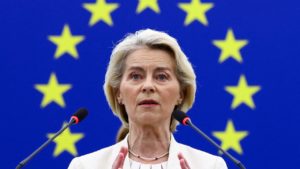
European Commission President Ursula von der Leyen said she would work with Canada to become the EU’s first “associate member” in her annual speech to the European Parliament in Strasbourg, France, on Wednesday.

"We want to bring the relationship with Canada to the highest level possible," von der Leyen said. "So, I would like to work with you on opening the door for Canada to be the first associate member of the EU."

She further stressed the need to maintain European ​independence in various sectors, including energy, raw materials and clean technologies.

To do that, EU countries will not only need to work together, but also have strong partners like Canada, whose Prime Minister, Mark Carney, is in Strasbourg and was warmly applauded by EU lawmakers as he arrived to listen to von der Leyen’s speech.

Von der Leyen, now in her second five-year term at the helm of the EU executive arm, walked up to and embraced Carney after mentioning the “associate ⁠membership” issue for Canada, and Carney got a standing ovation from the chamber.

Through its partnership with Canada, she called for EU states to tackle climate change, competition from China and other major challenges.

The bloc was dealing with "an openly hostile world", von der Leyen said, setting out priorities for the 27-nation EU for the year ahead.

She said solidarity among member states was the only possible solution. "Our path is clear. Building an independent Europe that has the power to act."

The 27-nation bloc faces ​war at its borders, with Russia’s invasion of Ukraine. On trade and other issues, it ⁠also faces stiff rivalry from US President Donald Trump’s United States and an increasingly assertive China.

The EU faces major headwinds at home ​as well, including the increasing popularity of a eurosceptic far-right, seen in regional elections in Germany that have weakened Chancellor Friedrich Merz. Opinion ​polls see Marine Le Pen as the strongest contender in next year's presidential vote in France.

"The state of our Union is the strongest it has ever been. The state of our Union can also feel as precarious as it has ever been," von der Leyen said.

Turning to trade, von der Leyen said the EU will use every possible means to reduce its "unsustainable" trade ​deficit with China. She said that the imbalance, with a goods trade deficit of €1 billion ($1.15 billion) a ​day last year, ⁠had reached a tipping point.

"Let me be clear: we will use all the tools at our disposal to rebalance our relationship. Words are good. But deeds are better," she said.

Von der Leyen also said the bloc will need to stay its ambitious course on ⁠mitigating climate change ​but also step up efforts to adapt to it, drawing on experiences from the last ​three months when the continent was hit by unprecedented heat waves and wildfires.

Jerusalem Post Staff contributed to this report.
NBC News helicopter crashes in Los Angeles, killing three

An NBC Los Angeles news helicopter crashed in the Chatsworth area of Los Angeles on Tuesday evening, killing three people and injuring a fourth, NBC said during a live broadcast.

NBC Los Angeles anchors on air identified the aircraft as their NewsChopper 4 helicopter.

"We've been telling you that we've been piecing it together here. We knew it was a news chopper. We knew we'd lost contact with our people out there, and we've just received the confirmation that, in fact, NewsChopper 4 went down just before 7 o'clock tonight in Chatsworth," NBC anchor Colleen Williams said.

Four patients were assessed at the scene, with three pronounced dead and one transported to a local hospital in an unknown condition, according to the Los Angeles fire department.

The NBC anchors did not say how many people had been on board the network's helicopter.

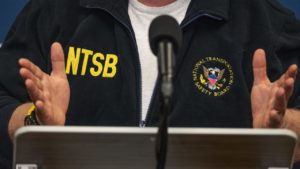
The National Transportation Safety Board and the Federal Aviation Administration will investigate the crash, the fire department said.

The helicopter crash occurred after a vehicle collision in the area involving a Los Angeles Metro bus and a passenger vehicle earlier on Tuesday that killed at least two people.

According to several media reports, several TV news helicopters were in the area reporting on the bus collision when the NBC helicopter crashed.

Los Angeles Mayor Karen Bass said she was "devastated" by the loss of life in the helicopter crash and the bus collision in Chatsworth, thanking emergency responders for their swift response.

NBC, owned by Comcast, and the Los Angeles Fire Department did not immediately respond to emailed requests for further details.

Britain restores diplomatic ties with Venezuela to support democratic transition process

Britain said on Tuesday it would upgrade its diplomatic relations with Venezuela, appointing an ambassador to the country, in a move which it said would strengthen its ability to play a role in supporting a transition to democracy.

"This decision is part of a broader international reengagement," the government said in a written statement to parliament.

Britain said the move did not signal endorsement of Venezuela’s disputed 2024 election or of any political faction, but reflected its longstanding policy of maintaining relations with the Venezuelan state.

Venezuela welcomed the decision. Oliver Blanco, Venezuela’s deputy foreign minister for Europe and North America, said in a post on X/Twitter that Caracas valued Britain’s move to raise the level of diplomatic relations.

“We reaffirm our willingness to deepen a respectful and constructive dialogue, as well as to promote cooperation in areas of common interest for our countries and to advance the recovery of resources that rightfully belong to the Venezuelan people,” Blanco said.

New information uncovered on Trump assassination attempt in Butler, says A-G Blanche

Attorney-General Todd Blanche said that there is new information on the shooter in the Butler assassination attempt on US President Donald Trump in a press briefing on Tuesday.

"It is new information about the shooter and about his background, about his history and that stuff that we didn't know before," Blanche told reporters during a White House press conference, without elaborating.

The attempted assassin, Thomas Crooks, fired eight shots at Trump with a rifle from a nearby rooftop during his speech at a 2024 campaign rally in Butler, Pennsylvania, before being killed by a Secret Service sniper.

A few hours prior to the A-G’s statements, Trump lambasted the FBI under the Biden administration in an X/Twitter post for not doing “what they should have with respect to the Lunatic who shot me in Butler, PA. By the time I got into Office, on January 20th, most of the information was missing, altered, corrupted, or gone. New info was just found! Why wasn’t it seen long ago?”

He continued, saying, "This was all a Democrat Plot, to get me out of the Election, that failed."

Trump added that ex-FBI director Christopher Wray, whom Trump appointed in his first term but later grew to hate, "should pay a price" for how the department responded to the assassination attempt "and certainly for the things he said."

Blanche, who was Trump's personal lawyer at the time of the assassination attempt, said during the briefing that he was with Trump as the investigation into the shooting was playing out, trying to ascertain what happened.

"His frustration and concern about what the former director was doing is something that is not new," Blanche said.

The Justice Department and FBI did not immediately respond to a Reuters request for comment. Wray could not be reached for comment.

Jonah Davidov contributed to this report.

Dutch farmers ignite highway fires, sabotage railways ahead of state opening of parliament

Dutch farmers started fires near highways on Tuesday, disrupting traffic as they protested against the government budget, while saboteurs also tied pipes to railway tracks ahead of the state opening of parliament.

Railway operator ProRail said pipes had been found attached to railways in more than 20 locations early on Tuesday, mainly in rural areas in the middle and the east of the country.

Later, fires erupted around midday in several places alongside highways, forcing authorities to close roads and seriously affecting traffic.

The fires were caused by angry farmers who had chosen government budget day to set hay bales and car tires alight, activist group Farmers Defense Force said.

“We feel like the country is on fire. Farmers feel as though their businesses are on fire because of the government’s plans,” spokesperson Sieta van Keimpema said.

Farmers Defense Force said it was not responsible for the railway sabotage, but added it could not rule out that angry farmers had acted individually.

The Dutch intelligence agency AIVD said it was investigating the railway sabotage alongside police and prosecutors. They declined to comment on their investigations.

The government's budget plans for 2027 were set out by King Willem-Alexander as he opened a new session of parliament on Tuesday afternoon.

The budget plans have sparked widespread protests in recent months, including by farmers arguing that they are being unfairly blamed for nitrogen pollution.

In his speech, written by Prime Minister Rob Jetten, the king said it would be "irresponsible" not to tackle the nitrogen issue, even though this could hurt farmers.

The government has promised financial compensation for farmers whose businesses would be hit by plans to restore nature reserves.

ProRail said it was clear that materials discovered on the railways had been placed there deliberately.

"We are therefore now classifying this as sabotage of the railway tracks," ProRail spokesperson Joke van der Cruysen said.

All trains in the vicinity of the track blockages were halted, while there were also serious disruptions elsewhere, including international services to Germany.

The pipes not only disrupted rail travel but also road traffic, as several level crossings had to remain closed, ProRail said.

Canada seeks private investment via long-term concessions for four largest airports, Carney says

Canada is seeking private investment through long-term concessions to operate the nation’s four largest airports as part of a campaign to boost the economy, Prime Minister Mark Carney said on Tuesday.

The airports are in Toronto, Montreal, Calgary and Vancouver. The Liberal government said last year it was looking at ways to boost investment in airports but at that stage did not give specific details.

Carney is welcoming dozens of global investors to Toronto this week, hoping to attract investment in more than 160 projects that he says are key to steering Canada’s economy through a trade war with the United States.

"We will seek private investment through long-term concessions to operate Canada's four largest airports,' Carney said in opening remarks to the summit.

"(We) will retain ownership of the underlying land and assets, but we will unlock their true value by bringing in new capital and expertise into their operations and growth."

Speaking on the sidelines of the summit, two asset managers told Reuters they would be interested in investing in airports.

Canadian labor groups have said they oppose privatization, arguing that it would raise costs for travelers.

Bill Gates: International governments are ‘way behind’ on AI, must work together to avoid issues

No government in the world is ready for the changes artificial intelligence will bring to society, Bill Gates said in an interview with Reuters, as he warned of the risks ahead.

The Microsoft co-founder and billionaire philanthropist had until recently been optimistic about AI, but has changed his position, warning of the threats to jobs, concerns about attacks and the dangers of addiction to AI companions.

“I don't think any government is nearly as deep on this as they have to be,” he said. However, he added that the technology has great potential to help the world's poorest if managed properly and accessed equally – and his namesake foundation said on Tuesday that it plans to spend at least $1 billion in the next two years on expanding access to AI.

Gates said he has been talking to world leaders about his concerns, including President Donald Trump and his team in the US, and said he aims to meet China’s President Xi Jinping later this year.

“Governments are way behind on this one,” he added.

But despite his concerns, Gates and his foundation hope AI can help narrow gaps between the richest and poorest, rather than widening them.

The foundation's $1 billion spending plan, part of its previously announced plans to spend $9 billion annually, will go to partners working in education, healthcare and agriculture, the foundation said. It also aims to help build the data foundations AI is built on, such as ensuring that large language models work in every language people speak.

“For health it’s hard to overstate what the potential is,” Gates said, from supporting frontline health care workers to discovering new drugs and vaccines.

But he said governments must work together to avoid problems, likening the arrival of AI to a disaster movie.

“There’s all sorts of movies where some aliens are coming, and magically the US and China and everybody comes together to solve the problem,” he said. “AI is kind of like this alien intelligence. It’s here, and we better do like it shows in those movies.”

In June, Gates appeared in front of Congress to testify about his relationship with the late convicted sex offender Jeffrey Epstein. Gates, who is not accused of any crimes, has repeatedly said he regrets his association with Epstein, who he hoped would donate to global health causes. Instead, the financier attempted to blackmail Gates over his extramarital affairs.

However, despite prompting an external review at his foundation, which found no payments to Epstein or participation in criminal activities, Gates said the links had not caused him or the foundation a significant reputational hit.

“In terms of having access to government leaders, or you know, journalists being willing to interview me, I don't see any diminishment,” he said, adding that the desire to draw on the foundation’s expertise to cut child deaths and end malaria had also not reduced “even one iota”.

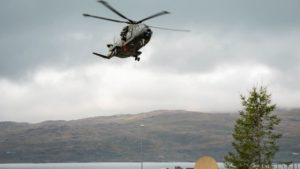
Russian frigate fires flares at NATO member Denmark’s military helicopter in international waters

A Russian frigate on Monday fired two flares towards a Danish military helicopter in international waters off the coast of Denmark, narrowly missing the aircraft, the Nordic NATO member country’s military said in a statement.

The helicopter had been on a routine mission to photograph the Russian frigate, the Danish defense command said.

Flares are pyrotechnics usually used as a warning signal at sea, it added.

Denmark will summon Russia's Copenhagen ambassador to a meeting over the incident, Defense Minister Jeppe Bruus told broadcaster TV2 separately.

The Russian embassy did not immediately respond to a request for comment outside of regular office hours.

NATO fighter jets shot down a drone that entered Lithuanian airspace from Belarus early on Tuesday morning, Lithuanian authorities said.

"A drone the just entered Lithuanian airspace was destroyed by NATO fighter jets," Lithuanian President Gitanas Nauseda said in a post on X/Twitter. "I thank Allied personnel for their swift response."

"With Russia intensifying its aggression against Ukraine, such readiness is vital for our region. Together with our NATO allies, Lithuania will defend its airspace."

On September 10, NATO allies caught Russian submersibles training to unleash a secret weapon designed to disable critical undersea cables without leaving any fingerprints.

A joint operation involving Britain, Norway and the United States tracked and confronted the Russian vessels at sea, the two officials said, speaking to Reuters on condition of anonymity. The vessels were prevented from completing their exercise and eventually left the area.

This comes as Western intelligence fears that the Kremlin is preparing for a conflict with NATO, Reuters reported.

China to impose no-fly zone over Beijing after light aircraft crashed into city’s tallest tower

China will impose a no-fly zone over its capital and tighten a citywide drone ban, state media reports showed, months after a small aircraft crashed into Beijing’s tallest building in a rare incident that raised questions about apparent security gaps in one of the world’s most tightly controlled airspaces.

“To strengthen airspace security management in the capital region, maintain order in aerial operations, and protect important targets on the ground and the lives and property of the public … China will designate a no-fly zone in and around the capital” to take effect on September 20, the state-run Beijing Daily said on Sunday.

Regular airline flights and emergency rescue operations would not be affected, the report said.

The exact scope, altitude limits and boundaries of the no-fly zone were not immediately clear.

The announcement came after a light general aviation aircraft crashed ​into the 108-story CITIC Tower, in the central business district, during evening rush hours on June 26. Local authorities said the crash killed the sole pilot and injured 13 others who were not on board.

The pilot had deviated from his approved flight area and lost contact with the airport in Beijing’s suburbs from which he took off. The 66-year-old man had long suffered from insomnia and anxiety, ​and his diary repeatedly mentioned ending his life, according to official statements.

Some companies offering scenic flights suspended services following the crash.

China's skies are among the most tightly controlled in ​the world, with the military retaining primary authority over airspace access and allocation. Beijing is among the most sensitive ​parts of that management framework.

There has been a permanent no-fly zone of roughly 100 sq km (39 sq miles) over the political ‌and ⁠ceremonial core of the Chinese capital, where regular commercial airline flights are also prohibited.

In a separate official statement over the weekend, Beijing authorities further tightened municipal drone restrictions, banning the possession, flying, and storage of drones over the entire city from November 15.

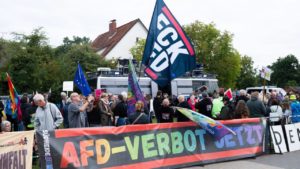
Germany’s far-right AfD makes gains in local elections, fended off by mainstream parties

The far-right Alternative for Germany party tripled its vote in Lower Saxony’s local elections from five years ago, coming in third in a race won by Germany’s leading conservative party.

The nationalist, anti-immigrant AfD siphoned off votes from Germany’s mainstream parties in the northwestern state, home to 8 million people. The election was seen as a test of the AfD’s recent surge, sandwiched between its win earlier this month in the eastern state of Saxony-Anhalt and two upcoming elections in the Baltic coast state of Mecklenburg-Western Pomerania and the capital, Berlin, on Sept. 20. 

Since the AfD was founded in 2013, German centrist leaders have blocked it from federal and state governments with what they call a “firewall,” as mainstream parties refuse to form coalitions with the AfD. The party advocates for deporting refugees, opposing multiculturalism, promoting social conservatism and diminishing Germany’s culture of Holocaust remembrance.

The municipal elections in Lower Saxony were watched unusually closely a week after the AfD’s historic victory in Saxony-Anhalt, laying the groundwork for it to form a state government for the first time. Sunday’s elections decided Lower Saxony’s mayors, district administrators and local council representatives. The state is home to Volkswagen, one of the world’s largest automakers.

The AfD garnered 15.9% in Lower Saxony, more than triple its 2021 share of 4.6%, according to preliminary results.

The center-right Christian Democratic Union (CDU), German Chancellor Friedrich Merz’s party, came in first with 27.2% of the vote, down from 31.7% in 2021.

The center-left Social Democrats (SPD), who lead a coalition government at the state level, came in second with 24.6% of the vote, compared with 30% in the last election. The Greens, a junior coalition partner to the SPD in the state government, saw their vote share drop slightly to 14.1% from 15.9% in the last cycle.

Voter turnout rose to 64.6% compared with 57% in 2021.

Lower Saxony, unlike the other states holding elections, is a large western region. The AfD traditionally has more influence in the east, and Germany’s municipal elections tend to hinge more on well-known figures from established parties, Roger Stöcker, a political scientist at Otto von Guericke University, told the Jewish Telegraphic Agency.

Although the municipal polls delivered some relief to beleaguered Merz after the CDU’s poor showing in Saxony-Anhalt, the AfD still notched significant wins on Sunday. In the industrial city of Salzgitter, AfD candidate Patricia Mair advanced to a runoff election for mayor against Frank Klingebiel, a CDU incumbent. The party also became the largest faction in Salzgitter’s city council, where it is projected to hold 13 seats, followed by the SPD with 12 and the CDU with 11.

The AfD chairman in Lower Saxony, Ansgar Schledde, described his party on Monday as the “clear winner of the evening.”

“We now have comprehensive representation in all district councils and city councils of district-free cities, as well as in hundreds of municipal and town councils,” Schledde said in a statement. “As of today, the AfD is a local party.”

Get help now

Send a message with a description of your problem and possible ways of assistance and we will contact you as soon as we consider your problem.