• English
  • Русский

What Venezuela’s renewed ties with Israel could mean for Iran – analysis

Four days before then-Venezuelan strongman Nicolas Maduro was captured by US forces on January 3, the United States Treasury announced sanctions against 10 Iranian and Venezuelan individuals and entities involved in the two countries’ weapons trade.

Among them was Venezuela’s state-owned Empresa Aeronautica Nacional SA, or EANSA. According to the US Treasury Department, the company maintained and oversaw the assembly in Venezuela of Mohajer-series unmanned aerial vehicles (UAVs) produced by Iran’s Qods Aviation Industries and had directly negotiated the purchase of millions of dollars’ worth of Mohajer-6 combat drones.

The relationship between the two companies dates back to 2006. The Iranian Mohajer-2 was produced in Venezuela as the Arpia and later developed into the armed ANSU-100, which the Treasury said was capable of launching Iranian-designed Qaem guided air-to-ground bombs. EANSA’s chairman had coordinated with members of both the Iranian and Venezuelan armed forces on UAV production inside Venezuela.

“The Treasury is holding Iran and Venezuela accountable for their aggressive and reckless proliferation of deadly weapons around the world,” Treasury Under Secretary John Hurley said when announcing the sanctions.

Now, a matter of months later, Venezuela’s relationship with Iran is back in the spotlight, but for very different reasons – reasons that may have Tehran worried. It was announced this week that Venezuela’s post-Maduro government is establishing an official consular channel with Israel for the first time in 17 years. After two wars with Israel in the past 14 months, Iran may worry its influence in Venezuela will now be tested.

Israel and Venezuela have not restored full diplomatic relations nor announced the reopening of embassies, but after talks between Venezuelan Foreign Minister Felix Plasencia and Israeli Foreign Minister Gideon Sa’ar, they agreed to establish a mechanism to provide consular services and to continue technical cooperation that began after Israel sent personnel to assist Venezuela following June’s devastating earthquakes.

“The two countries agreed to allow the continuation of bilateral technical cooperation arising from the emergency and recovery efforts following the double earthquake,” Plasencia said in announcing the agreement, adding that they would establish a mechanism for consular services.

“Both governments recognize the importance of the relationship between the State of Israel and the Jewish community in Venezuela, which constitutes an important historic bridge of friendship between the two countries,” Venezuela’s government said in a statement, which was also issued by Israel’s Foreign Ministry.

It is the identity of Venezuela’s new partner, rather than any specifics within the agreement, that makes it relevant to Iran, and a sign of how far things have come since the turn of the century. Many countries around the world maintain relations with both the Islamic Republic and Israel, but few are so close to Iran and have seen such a diplomatic about-face with regard to the Jewish State.

Former president Hugo Chavez condemned Israel during the 2006 Lebanon war in extreme terms, accusing Israel of “going mad and inflicting on the people of Palestine and Lebanon the same thing they have criticized, and with reason: the Holocaust. But this is a new Holocaust.”

In August of that year, Chavez had called for Israeli leaders to face a trial for genocide, stating the Jewish state had “done something similar or, perhaps worse, who knows, than what the Nazis did.”

In 2008, during a diplomatic disagreement with neighboring Colombia over the latter’s intrusion into Ecuador, Chavez said: “the Colombian government has become the Israel of Latin America.” Just one year later, during Operation Cast Lead in Gaza, Venezuela expelled Israel’s ambassador and broke diplomatic relations, with Chavez declaring during a TV broadcast, “Damn you, State of Israel.”

In 2010, Chavez accused Israel and the Mossad of plotting against him and denounced Israel as a “terrorist and murderous state.”

While relations with Israel reached new lows under Chavez, Caracas also saw a deepening relationship with Iran. Chavez and former Iranian president Mahmoud Ahmadinejad, both self-styled anti-American revolutionaries, struck up a close rapport after Ahmadinejad took office in 2005, and the two leaders visited each other’s countries three times apiece between 2005 and 2007. On a July 2006 trip to Tehran, Chavez met with former supreme leader Ayatollah Ali Khamenei and was awarded the Higher Medal of the Islamic Republic of Iran, the country’s highest state honor – a gesture that followed Chávez’s public backing of Iran’s nuclear program at the UN earlier that year. During the same visit, he accused then-president George W. Bush of having a “relationship with the devil.”

By the end of Chavez’s presidency in 2013, Iran and Venezuela had signed hundreds of agreements covering energy, banking, housing, agriculture, cement, and automobile production. The Center for Strategic and International Studies later estimated Iranian investments and loans in Venezuela at between $15 billion and $20 billion by 2012, although many projects either stalled or produced substantially less than their governments had promised.

However, under Maduro, the relationship took on a different meaning. US sanctions progressively restricted both countries’ access to conventional financial, energy and industrial markets, giving each something the other increasingly needed.

The extent of that dependence was evident by 2020, when the deterioration of Venezuela’s refining industry led to acute gasoline shortages. Iran supplied fuel, refinery components, and technical assistance to the isolated South American nation. The two governments subsequently developed oil swaps under which Iran supplied condensate and crude to Petroleos de Venezuela, SA (PDVSA), Venezuela’s state-owned national oil and gas company.

Venezuela imported around 73,000 barrels per day of Iranian crude and condensate in 2022 and approximately 40,000 barrels per day in 2023, according to company records and shipping data cited by Reuters.

Iran was also working inside Venezuela’s refining infrastructure. Tehran agreed to a roughly €110 million overhaul of the 146,000-barrel-per-day El Palito refinery, while plans were developed for Iranian state refiner NIORDC to work on the much larger Paraguana refining complex.

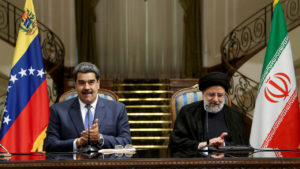
The relationship was further strengthened in June 2022, when Maduro and then-Iranian president Ebrahim Raisi signed a 20-year cooperation plan covering oil, petrochemicals, defense, agriculture, tourism, and culture, including Iranian repairs to Venezuelan refineries and the export of Iranian technical and engineering services.

“Venezuela has shown exemplary resistance against sanctions and threats from enemies and Imperialists,” Raisi said at the time. “The 20-year cooperation document is testimony to the will of the two countries to develop ties.”

Khamenei was explicit about what Iran believed it had achieved in Latin America.

“The successful experience of the two countries showed that resistance is the only way to deal with these pressures,” he said during Maduro’s visit. “The two countries have such close ties with no other country, and Iran has shown that it takes risks in times of danger and holds its friends’ hands.”

“You came to our aid when the situation in Venezuela was very difficult, and no country was helping us,” Maduro told Iranians in response to Khamenei’s comments.

Given such close relations and the departure of both Maduro and Khamenei from the geopolitical scene, the changes taking place in 2026 cannot be overstated.

The Iranian-Venezuelan alliance also gave Iran an established state partner in the Western Hemisphere willing to cooperate with the Islamic Republic’s defense industry and support its challenge to American policy.

There were the occasional signs that this arrangement was becoming less attractive to Caracas before Maduro’s removal.

In March 2024, Reuters reported that PDVSA had fallen behind on its side of oil-swap agreements, prompting Iran to halt cargoes in May 2023. Projects had stalled, and the two governments had failed to come close to their ambitions for $25 billion in trade and investment.

Less than $10 billion in business remained active, according to the Reuters report. More significantly, when Washington temporarily relaxed sanctions and Venezuela gained greater access to international markets, PDVSA began favoring customers that could pay cash rather than sending cargo to Iran under the swaps.

Iran’s greatest economic value to Venezuela came when Venezuela had few alternatives. If access to US and other Western markets, investment, technology, and customers is restored, Iranian cooperation has to compete with options that sanctions had previously removed.

Maduro’s capture helped to speed up that change.

The US made clear that reducing Iranian influence was among its objectives, and just days after Maduro was removed, American officials were pressing acting President Delcy Rodríguez to distance Venezuela from Iran, Russia, and China. Initial US intelligence assessments reportedly questioned whether Rodríguez, Maduro’s former vice president, would comply, but the developments that followed have moved consistently in that direction.

Caracas began an exploratory process with Washington within days of Maduro’s removal. In March, Venezuela and the US formally agreed to restore diplomatic and consular relations.

Then, in July, came a public dispute with Tehran.

On July 28, Venezuela summoned the Iranian ambassador and presented him with a formal diplomatic protest over what its Foreign Ministry called “contemptuous and inappropriate” remarks concerning Venezuelan institutions and authorities. Reports linked the dispute to Iranian Foreign Minister Abbas Araghchi’s assertion, while discussing negotiations with Washington, that Iran was “not Venezuela.”

Venezuela went further than simply complaining about the remark. The Foreign Ministry demanded “the cessation of any allusion or comparison that undermines the dignity, sovereignty, institutional integrity, or good name” of Venezuela.

When set against Khamenei’s description four years earlier of two countries with ties so close that neither possessed an equivalent relationship elsewhere, it is a mighty fall from grace.

Less than two weeks after Venezuela protested against Iran, the establishment of official consular cooperation with Israel was announced.

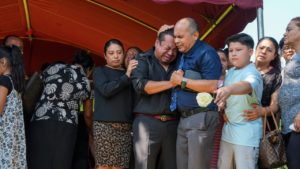
The move also came just one month after Israel and Israeli aid organizations rushed to Venezuela to help deal with the aftermath of an earthquake which left over 6,300 dead according to latest estimates, and over 70,000 injured. The IDF also traveled to Venezuela to help with the aid efforts.

Rodríguez thanked Israel last month for sending “a highly specialized and professional group” after the twin earthquakes that recently shook the country. The team, she said, was brought in through the efforts of Venezuela’s Jewish community, allowing the Venezuelans “to connect with the Israeli government,” and was helping determine which damaged buildings might still hold survivors and whether they still contain bodies needing to be recovered.

This does not automatically mean that Caracas has decided to end its relationship with Tehran. Venezuela has yet to announce any withdrawal from the 20-year cooperation agreement or termination of Iranian military cooperation. The infrastructure developed during two decades of relations cannot be dismantled through a consular agreement.

The more useful question is what Venezuela still requires from Iran.

In 2022, Maduro could tell Tehran that Iran had helped when “no country was helping us.” In 2026, that is no longer applicable.

Venezuela again has access to diplomatic and economic arenas with the West that were previously unavailable, and its government has demonstrated that it is prepared to publicly rebuke the Iranians. With renewed ties with Israel, it offered Venezuela another friendly option when it appeared no one else would help them. And for the Iranians, that must be a worrying prospect.
Poland says it arrested Russian hired to kill ‘inconvenient’ Ukrainian-American citizen

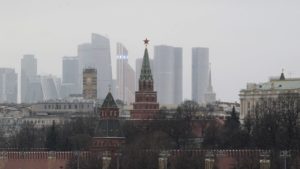
Poland has arrested a Russian man who was hired by Moscow to kill a Ukrainian-American citizen in Warsaw, Polish Prime Minister Donald Tusk said on Thursday.

The Russian was detained on August 7 and had been recruited to kill a man who was "inconvenient to the Putin regime," Tusk told journalists.

The Russian embassy in Warsaw did not immediately respond to an emailed request for comment. Moscow has regularly dismissed accusations by European powers of attacks, saying the West is stoking anti-Russian paranoia.

"Thanks to the truly brilliant action of our services … we detained a Russian citizen recruited by Russian intelligence services," Tusk said.

The Russian had been hired to kill a man who had both Ukrainian and US passports, Tusk said, without giving any more information on his identity.

"At the last minute, thanks to the action of the Internal Security Agency and the police, we managed to prevent this execution, this attack," Tusk added.

In June, a Russian artist critical of President Vladimir Putin was shot and killed in the eastern Polish town of Biala Podlaska, prosecutors said.

Poland says its role as a hub for military and other supplies to neighboring Ukraine has made it a target for Russian espionage and attacks.

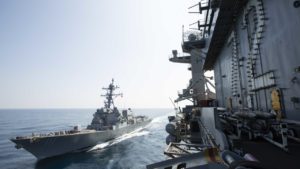
USS Abraham Lincoln conditions under scrutiny after reports sailors attempted to jump overboard

US Senator Richard Blumenthal (Connecticut) has demanded a formal inquiry into the conditions aboard the USS Abraham Lincoln in a letter sent Wednesday to US Defense Secretary Pete Hegseth and Acting US Navy Secretary Hung Cao.

Blumenthal, who himself served in the US Marine Corps Reserve, sent the letter following reports of several US Navy service members stationed aboard the USS Abraham Lincoln attempting to jump overboard as the aircraft carrier enters its ninth month of deployment at sea.

Two American newspapers that cover matters related to the US military, Navy Times and Stars and Stripes, originally reported on the matter earlier this week. 

The carrier has spent nearly 250 consecutive days at sea without making land since its departure from San Diego in November 2025. It was originally deployed for duty in the South China Sea before being rerouted to the Middle East ahead of the outbreak of Operations Epic Fury in February 2026.

“The Lincoln’s extended deployment raises broader questions about the Navy’s ability to sustainably generate carrier forces while preserving service member well-being, maintenance, schedules, fleet readiness, and the capacity to respond to future contingencies,” wrote Blumenthal in his letter.

Citing reports of supply shortages, water contamination, and several other issues that have arisen over the past months, Blumenthal granted the US Navy two weeks, until August 27, to provide answers.

In his questions posed to the naval force, Blumenthal requested details surrounding Lincoln’s extended deployment, how the Navy assesses the mental health and morale of its soldiers, and how it has worked to solve the quality-of-life problems that have been reported on board the carrier.

Further, Blumenthal asked the Navy to explain what military objective Lincoln’s ongoing deployment is meant to achieve and how the US Defense Department “assess[es] whether the carrier’s continued presence is necessary to accomplish that objective.”

US Senator Ruben Gallego (Arizona) echoed Blumenthal in a post to X/Twitter on Thursday, saying that he is looking into conducting an official oversight visit with a bipartisan Senate Delegation due to the reports.

“Unlike Donald Trump, I’ve seen active duty. The way he’s treating our service members as he carries out this illegal war is not just disgusting; it’s dangerous,” Gallego wrote. “These sailors are owed a sense of when they will go home.”

“The stories of crew members threatening to jump off the ship are a frightening alarm bell as to how bad the situation has become: moldy showers, sporadic hot water, rationed meals and soap, broken toilets, and grueling 12- to 16-hour shifts with no days off.”

“Congress must do its duty to provide oversight and hold the administration accountable for these actions,” he said.

Late last week, Cao and several other senior Navy officials had reportedly held a town hall-style meeting with the families of the service members aboard the Lincoln.

One of the spouses told Cao and the other officials that her husband had sent her a message on Thursday saying that “he hopes he doesn’t wake up tomorrow,” reported Stars and Stripes, citing one of the meeting attendees.

According to the spouse, officials didn’t directly address that or other similar statements presented to them by concerned family members, but did affirm that those aboard Lincoln had access to mental health professionals, chaplains, and doctors.

Navy Times reported that Cao said that the US Navy is preparing the USS Theodore Roosevelt carrier strike group to relieve Lincoln, but could not provide a timeline due to “operational security.”

Annabelle Loma, the wife of one of the service members who tried to jump from the aircraft carrier, told Navy Times that her husband had been repeatedly overextended before his attempt. 

“He’s scared,” Loma told Navy Times. “He thinks he’ll get a dishonorable discharge, and just because he was burnt out, his 13-year career is ruined, just like that. That’s not fair, that’s not right. That’s not what he should be worrying about right now.”

According to Navy Times, the Lincoln’s ombudsman had initially called Loma to inform her of the incident and that her husband was put on medical hold.

She has not heard anything else from the US Navy “in recent weeks,” Navy Times reported.

Both papers gave details of several other attempts made by service members to jump overboard, including an incident where the jumper was restrained by other soldiers who happened to be on watch.

“When she can email me, she’s definitely down,” Shelby Sander, whose mother is stationed on Lincoln, told Navy Times. “I think they’ve had five weeks of non-stop combat operations or something like that, so that makes it really tough to communicate consistently or even know if we’ll be able to. It sucks.”

“I don’t know how to enjoy starting my senior year when my mom isn’t here, you know?” Sanders said. “Will she be back before homecoming? My birthday? Christmas? I have no idea, and that’s all that I think about.”

Manuel Guevara, the father of a soldier serving on Lincoln, told Navy Times that his son had sounded “exhausted, down and worried the last time they spoke.”

“Us being out there keeps wars out of our country, but it sucks having your family away. It makes the homecoming that much sweeter, but the uncertainty of when that day will come starts to eat away at you,” Guevara shared with Navy Times. 

“I don’t want to worry that the circumstances of this deployment will get the best of my son, and he doesn’t make it back home,” Guevara said. “That’s an unbearable burden on my heart.”

Explosion in Rotterdam kills at least one person, is under investigation

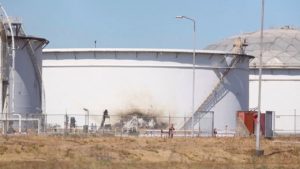
A blast at a storage facility for petroleum products at the Netherlands’ Rotterdam Port killed one person and wounded several others on Thursday, officials said, adding that the cause was unknown.

A spokesperson for major energy commodities trading company Gunvor said an "incident" occurred during maintenance work on a storage tank. A police spokesperson said that there was no immediate sign of sabotage and that all possible scenarios were under investigation.

Rotterdam is Europe’s largest port and comprises oil refineries, liquefied natural gas terminals and multiple petrochemical facilities. Shell, Exxon Mobil, BP, and Gunvor Energy are among the energy majors operating at the port.

The explosion occurred at around 11:30 a.m.

Gunvor said it was cooperating with local authorities.

Shell said its operations at the port were unaffected by the blast.

A Rotterdam Port spokesperson said LNG terminals were not affected.

ExxonMobil shut all units at its 191,000 barrels/day Rotterdam refinery due to a power outage, consultancy Wood Mackenzie said in an alert to clients seen by Reuters.

ExxonMobil did not immediately respond to a request for comment.

Rotterdam Port said there was no connection between the blast and the power outage.

Guatemalan man dies after medical emergency in NJ ICE detention facility, DHS says

An immigrant from Guatemala who was taken to a US Immigration and Customs Enforcement detention facility in Newark, New Jersey, in July experienced a medical emergency and died after hospitalization, President Donald Trump’s administration said.

Jose Chajon-Raxon was detained by ICE at the Delaney Hall detention facility on July 18 and experienced a medical emergency the next day, the Department of Homeland Security, of which ICE is a part, said in an emailed statement on Wednesday.

A nurse responded to the medical emergency and "witnessed Chajon-Raxon experiencing seizure-like activity," the DHS said, adding that medical workers were called and Chajon-Raxon was taken to a hospital.

The DHS said Chajon-Raxon was "released from ICE custody on July 22" but did not provide more details on that. The DHS statement did not mention when Chajon-Raxon died.

Delaney Hall in Newark has previously come under scrutiny from human rights advocates and Democrats following the deaths in ICE detention of a man from El Salvador named Edwin ​Lopez-Cornejo and another from Haiti named Jean Wilson Brutus. The Salvadoran man died this month after a medical emergency, while the Haitian man died in December.

ICE was not notified of Chajon-Raxon's death as it was "not responsible when an individual passes away weeks after leaving their custody," the DHS said.

Democratic US Representative Rob Menendez said he had been given conflicting information on Chajon-Raxon's death, adding that he went to the ICE facility on August 3 in an oversight visit.

More than 50 people have died in ICE custody nationwide since President Donald Trump ‌took office ⁠in January last year. Rights groups have repeatedly raised concerns about medical care and living conditions at the facilities.

ICE says detainees are given appropriate medical care.

The agency has been the face of Trump’s immigration crackdown. The Republican president says the crackdown aims to improve domestic security.

Rights groups say the crackdown has ⁠violated ​free speech and due process rights and ​created an unsafe environment, particularly for ethnic minorities, who have raised concerns about racial profiling.

US charges 11 in $100K-per-person scheme arranging 1,000 sham marriages for Chinese nationals

The US Justice Department on Wednesday charged 11 people in a decade-long scheme that arranged about 1,000 sham marriages to allow mostly Chinese nationals to achieve legal immigration status in the United States, according to court documents.

Foreign nationals paid a group of six “facilitators” as much as $100,000 each to be paired up with a US citizen and obtain legal residency, according to an indictment unsealed in federal court in Manhattan. US citizens were paid as much as $30,000 to agree to the marriages, according to the indictment.

Participants in the scheme then helped the newlyweds submit paperwork to the US Department of Homeland Security to allow the Chinese national to become a lawful permanent resident.

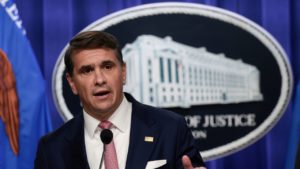
Attorney General Todd Blanche described the scheme as "one of the largest marriage fraud prosecutions in US history" and said it showed "how far people will go to cheat our immigration system."

The announcement follows an executive order signed by President Donald Trump last week aimed at restricting “birth tourism,” after the US Supreme Court ruled in favor of broad citizenship rights for babies born in the United States.

The State Department said on Wednesday it started an effort to review the activities of visa holders with the aim of cracking down on women coming to the US solely to attain citizenship for their child.

Apache helicopter crash in Texas killed two US Army soldiers, sparked large fire

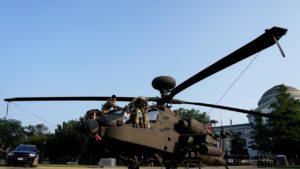
Two US Army soldiers died when an Apache military helicopter attached to the service’s Fort Hood base crashed into a field in Texas on Wednesday, sparking a large grass fire, officials said.

The accident occurred in Bell County, about 60 miles (100 km) north of the state capital Austin, said Cliff Coleman, a spokesperson with the Bell County Sheriff’s Office.

The Bell County justice of the peace declared dead two people who had been on board, Coleman said.

“Today, an Apache helicopter crashed in Bell County during Fort Hood operations, killing two members of our military,” Texas Governor Greg Abbott said on X/Twitter.

Fort Hood confirmed in a statement that an AH-64 attack helicopter crashed and two soldiers died but withheld their identification pending notification to their families.

Images provided by Coleman showed firefighters examining burning debris amid a large patch of charred grass, with smoke billowing from the scene. Several local fire departments responded to the blaze, he said.

Israel sends aid delegation to Colombia in aftermath of earthquake that killed at least 250 people

Prime Minister Benjamin Netanyahu said an aid delegation would be immediately dispatched to Colombia in a statement from the Government Press Office on Wednesday evening.

Colombian President Abelardo de la Espriella asked Netanyahu to send a delegation to the country following an earthquake with a magnitude of 7.4 on Monday, the statement explained. 

The earthquake, which occured in the heart of Colombia’s coffee region, killed at least 250 people and reduced multi-story buildings to rubble in cities such as Pereira and Cali.

It also caused one of the towers of a historic cathedral in the city of Manizales to crack apart.

Emergency teams aided by police, soldiers, and volunteers have been working with excavators and, at times, their bare hands, hunting for survivors beneath debris.

This request came amid efforts to improve relations between the two countries, part of Foreign Minister Gideon Sa’ar’s broader initiative to improve relations with South American countries, with the Foreign Ministry designating 2026 as the “Year of Latin America.”

Colombia recognized Israel’s sovereignty over the Golan Heights in a statement released by the country’s Foreign Ministry on Monday.

In the statement, published on X/Twitter, the ministry recognized Israeli control over the area as “an essential component of its national defense and its ability to protect and safeguard its citizens."

The recognition resulted from a commitment made by both Israel and Colombia on Saturday, the ministry said.

Goldie Katz and Reuters contributed to this report.

Serial UK sex attacker jailed for life for double murder, rape after police failings

A British serial sex attacker will spend the rest of his life in jail, a judge said on Wednesday, after he was convicted of two murders and rape following an escalating spree of sexual offenses that police and prosecutors failed to stop.

Simon Levy, 40, was found guilty last week of the murder of Carmenza Valencia-Trujillo in March 2025 and of Sheryl Wilkins in August 2025, and of the rape and serious assault of a third woman in January that year.

A life sentence is the most severe punishment in the UK and is extremely rare – with only just over 70 people currently serving the term in England and Wales, according to data from the London Metropolitan Police.

Police had arrested Levy several times for sexual assaults against women on rush-hour trains before he was arrested on suspicion of murdering Valencia-Trujillo, 53, in April 2025.

But Levy was released and sexually assaulted five women before he killed Wilkins, 39, in a brutal attack.

London's Metropolitan Police said Levy was released because they were then unable to confirm any third-party involvement in Valencia-Trujillo's death.

Its chief, Mark Rowley, told reporters the force "could have done better, definitely," but added that "the justice system needs to do its job better."

Levy's crimes and the failures by police and prosecutors that allowed him to continue offending have prompted criticism, coming after a report in December said British police must ensure early intervention in cases of predatory behavior.

Harriet Wistrich, CEO of the Centre for Women's Justice, said: "The catalog of combined failures in this case provides terrifying evidence … that our criminal justice system is in a state of collapse."

Judge Mark Lucraft said Levy was "clearly someone who ruthlessly exploits others for your own personal, sexual satisfaction" as he sentenced him to a whole-life order for the murders of Valencia-Trujillo and Wilkins.

He was also sentenced for two counts of rape, causing grievous bodily harm with intent and intentional strangulation in relation to a third woman.

Levy was separately convicted in February of sexually assaulting 10 women on London trains between October 2023 and May 2025, with six of the attacks in early 2025, and an 11th charge of sexually assaulting a prison officer in April 2022.

He was arrested in 2024 and early 2025 by British Transport Police, including after he was a suspect for rape and Valencia-Trujillo's murder, but was granted bail.

The Met has referred itself to the police watchdog for downgrading him to a medium-risk offender in 2024, while BTP and the Crown Prosecution Service have also admitted some failures.

London Mayor Sadiq Khan said in a statement that he was “appalled by his crimes and the failures across multiple agencies,” calling for a multi-agency review to try and stop it from happening again.

Jerusalem Post staff contributed to this report.

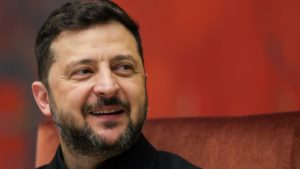
Ukraine has retaken 745 sq km in ‘precision’ operation this year, Zelensky says

Ukrainian forces have liberated 745 square km (288 square miles) of Russian-occupied land this year across a swathe of the southeastern front, President Volodymyr Zelensky said on Wednesday, hailing an operation he said went “exactly as planned.”

Ukraine’s military has sought to heap pressure on Moscow’s war effort in recent months, counterattacking on parts of the 1,200-km front and striking logistics and energy infrastructure.

Zelensky said 26 settlements in the Dnipropetrovsk, Donetsk, and Zaporizhzhia regions had been brought back under Kyiv's control. They are located along an approximately 60 km stretch of the front where the borders of the three regions meet.

"This offensive operation of ours was carried out with precision – exactly as planned," he said on X, crediting Kyiv's air-assault forces and other units.

According to a battlefield map by Ukrainian open-source group DeepState, much of the area remains in a grey zone that is not fully controlled by either side. Some is marked as still Russian-controlled.

A video posted by Ukraine’s General Staff on Wednesday featured mostly drone-shot footage of its troops holding up the Ukrainian flag in the freed settlements. Reuters could not independently verify it.

Russia’s battlefield advances have slowed this year across much of the front, analysts say, though its forces are still closing in on key cities in Ukraine’s eastern Donetsk region.

Moscow has demanded Kyiv give up the rest of the industrialized Donetsk region, which it refuses to do.

Get help now

Send a message with a description of your problem and possible ways of assistance and we will contact you as soon as we consider your problem.